 Rustango
 Caching
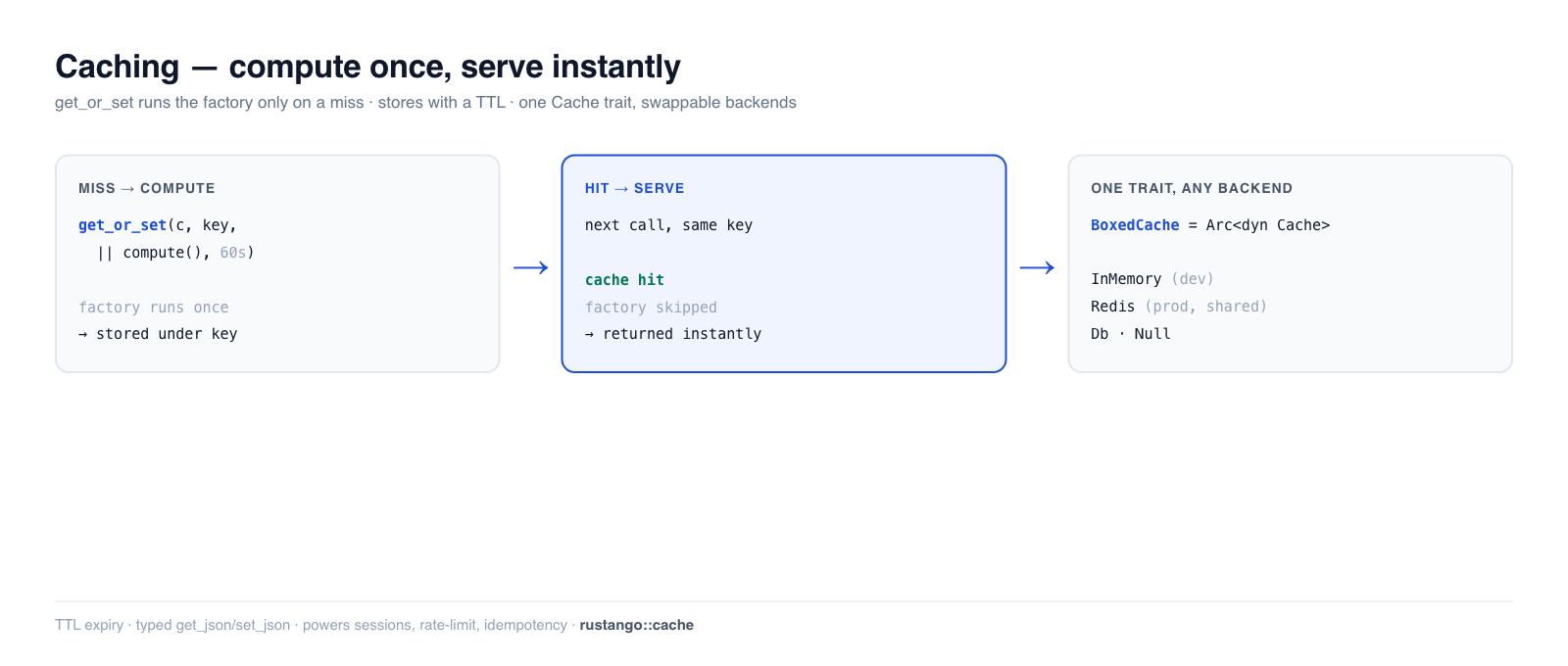
Caching stores the result of expensive work — a heavy query, a rendered
fragment, a third-party API call — so the next request gets it instantly instead
of recomputing. Rustango gives you one Cache trait with swappable backends
(in-memory, Redis, database), a compute-on-miss helper (get_or_set), and typed
JSON helpers. Swap the backend without touching a single call site — like
Django's cache framework or Laravel's Cache facade.
New to a term here? cache, TTL, key, backend — see the glossary.
Source:
rustango::cache(Cache,InMemoryCache,NullCache,get_or_set,get_json,set_json,BoxedCache,from_settings) — behind thecachefeature (on by default).RedisCacheneeds thecache-redisfeature (off by default).Runnable version: every snippet is copied from
cache_doc.rs(cargo test -p rustango --test cache_doc); the database backend is dogfooded on SQLite bycache_db_backend_sqlite_live.rs.
Table of contents
- Step 1 — Pick a backend
- Step 2 — get / set / delete
- Step 3 — get_or_set (cache-aside)
- Typed JSON values
- TTL and expiry
- Swapping backends
- Reference
- See also
Step 1 — Pick a backend
Every backend implements the same Cache trait, so your code is identical
whichever you choose. App code holds a BoxedCache (Arc<dyn Cache>) and
never names the concrete type:
use rustango::cache::{BoxedCache, InMemoryCache};
use std::sync::Arc;

let cache: BoxedCache = Arc::new(InMemoryCache::new());
| Backend | Feature | Use for |
|---|---|---|
InMemoryCache | cache | dev, tests, single process (per-process HashMap + TTL) |
RedisCache | cache-redis | production; shared across replicas |
DbCache | cache | production without Redis; a rustango_cache table |
NullCache | cache | disable caching (every read misses) — handy in tests |
Step 2 — get / set / delete
The core of the trait is four async methods. set takes an optional TTL
(None = no expiry); get returns Option<String> (None on a miss):
use rustango::cache::{Cache, InMemoryCache};

let cache = InMemoryCache::new();

assert_eq!(cache.get("greeting").await?, None);     // miss
cache.set("greeting", "hello", None).await?;        // store, no expiry
assert_eq!(cache.get("greeting").await?.as_deref(), Some("hello"));
assert!(cache.exists("greeting").await?);

cache.delete("greeting").await?;                    // gone
There are batch variants too — get_many / set_many / delete_many.
Step 3 — get_or_set (cache-aside)
This is the one you'll reach for most. get_or_set returns the cached value, or
— on a miss — runs your factory, stores the result with a TTL, and returns it.
The factory only runs on a miss:
use rustango::cache::get_or_set;
use std::time::Duration;

let stats: HomeStats = get_or_set(
    &*cache,                       // &dyn Cache
    "home:stats",
    || async { compute_home_stats(&pool).await },   // runs only on a miss
    Some(Duration::from_secs(60)),                   // cache for 60s
).await?;
The backing test calls get_or_set twice for the same key and asserts the
factory ran exactly once — the second call is served from the cache.
Invalidate on write. Cache-aside means stale data until the TTL expires. For data that changes, also
delete(key)when you write it — e.g. from apost_savesignal — so the next read recomputes.
Typed JSON values
get_json / set_json serialize any Serialize/Deserialize type to JSON, so
you cache structs and lists, not just strings:
use rustango::cache::{get_json, set_json};

#[derive(serde::Serialize, serde::Deserialize)]
struct Profile { id: i64, name: String }

set_json(&*cache, "profile:7", &profile, None).await?;
let back: Option<Profile> = get_json(&*cache, "profile:7").await?;   // None on a miss
(get_or_set uses these under the hood, which is why its value type must be
Serialize + Deserialize.)
TTL and expiry
Pass a Duration to set (or get_or_set) and the entry disappears after it.
Verified: a 50 ms entry is readable immediately and gone after 80 ms.
cache.set("flash", "x", Some(Duration::from_millis(50))).await?;
// ...50ms later...
assert_eq!(cache.get("flash").await?, None);   // expired
InMemoryCache::with_default_ttl(d) sets a default TTL applied when you pass
None.
Swapping backends
Because everything is the Cache trait, switching from in-memory to Redis is a
one-line change at startup — usually driven by config so it differs per
environment:
// Build the cache from `[cache]` settings (backend = "memory" | "redis" | "db" | "null").
let cache: BoxedCache = rustango::cache::from_settings(&settings.cache);
In production, point it at Redis (shared across all your replicas):
use rustango::cache::RedisCache;   // needs the `cache-redis` feature
let cache: BoxedCache = std::sync::Arc::new(RedisCache::new("redis://localhost").await?);
Same get / set / get_or_set calls — only the constructor changed.
Reference
Cache trait: get · set(key, value, ttl) · delete · exists ·
get_many / set_many / delete_many · get_or(key, default).
Free helpers: get_or_set(cache, key, factory, ttl) ·
get_json / set_json · from_settings(&CacheSettings).
What's built on the cache: server-side sessions,
distributed rate limiting (CacheRateLimitLayer), idempotency
keys, and feature flags all take a BoxedCache — so one Redis instance backs
all of them.
See also
- Background jobs — the other half of keeping requests fast (defer work instead of caching its result).
- Sessions — a server-side store built on
Cache. - Middleware —
CacheRateLimitLayershares a counter across replicas via the cache. - ORM cookbook — invalidate cached reads from a
post_savesignal.