 Rustango
 Serializers
A serializer turns a model instance into a typed, JSON-ready shape — and back
again on the way in. It's Rustango's answer to a Django REST Framework
ModelSerializer or a Laravel API Resource: declare a struct, annotate its
fields, and you get controlled output (rename, hide, compute, nest), field- and
object-level validation, and a clean hook into ViewSets.
One thing to internalise up front, because it differs from DRF: a Rustango
serializer shapes data, it doesn't persist it. There's no serializer.save()
that writes to the database — the ORM does that. The serializer maps a model to
JSON (from_model → to_value), declares which fields are writable, and
validates. You compose it with the ORM and ViewSets rather than routing writes
through it.
New to a term here? — serializer, model, ORM, DRF? The glossary defines each in plain language.
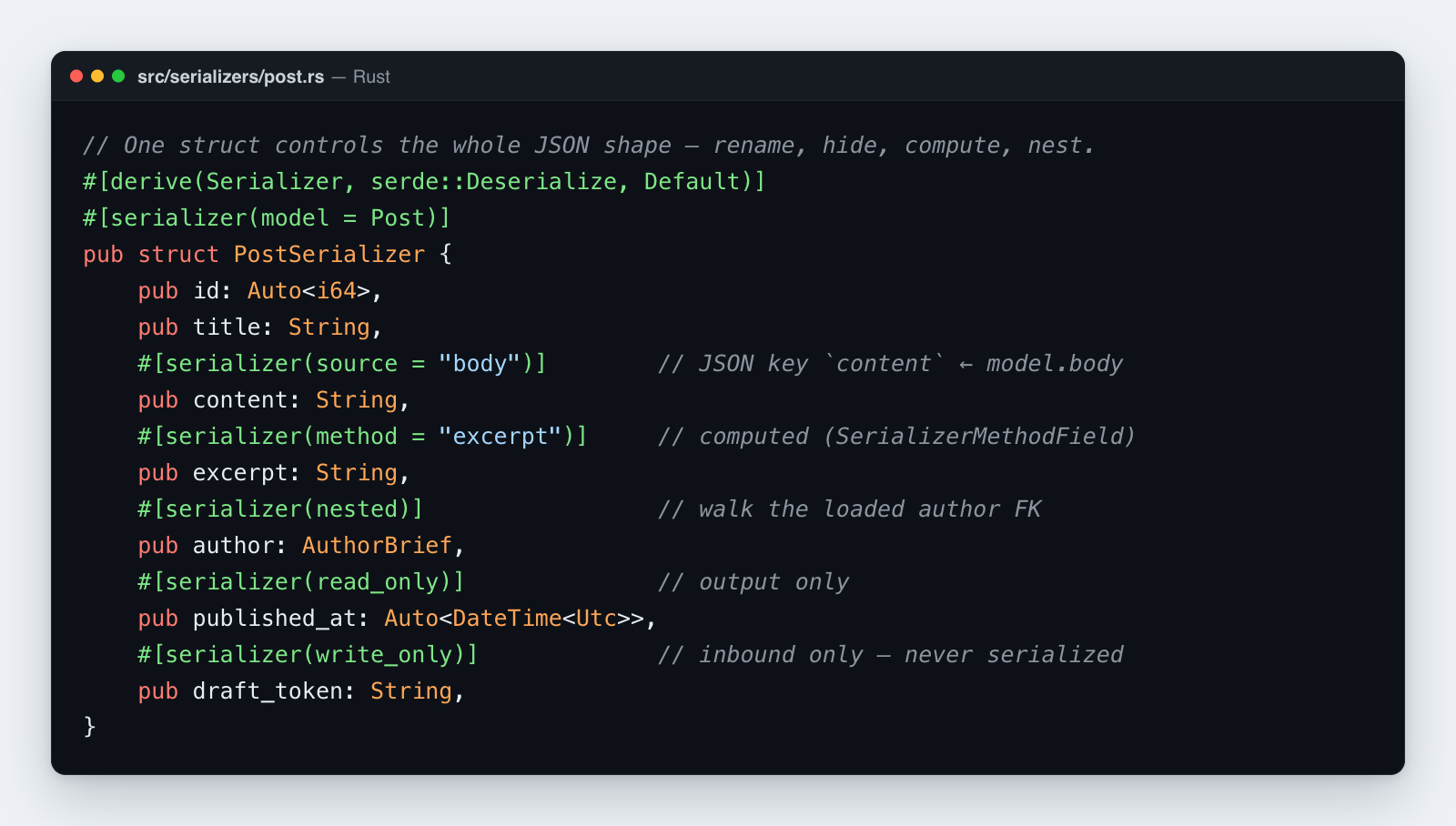
Source:
rustango::serializer(ModelSerializer,#[derive(Serializer)], the#[serializer(...)]field attributes) — behind theserializerfeature (on by default).Runnable versions: the minimal serializer ships in the tested
getting_started_blogexample, and the derive's full behavior is covered by the framework's own unit tests —crates/rustango/tests/serializer_derive.rsandserializer_cross_validate.rs. If a snippet looks off, diff against them.
Table of contents
- Quick start · The
ModelSerializertrait - Field attributes — the full reference
- Computed fields · Nested serializers · Collections · Slug fields
- Validation · Unique-together
- Hyperlinked output · Serializing lists
- Using a serializer with a ViewSet · Validating in a custom handler
- OpenAPI · Scaffolding · Tweaks & limits
Quick start
A serializer is a plain struct with #[derive(Serializer)] and a
#[serializer(model = …)] pointing at the model it maps from. It needs two
companion derives: serde::Deserialize (so it can also parse incoming JSON) and
Default (so excluded/optional fields can be initialised).
use rustango::Serializer;
use rustango::serializer::ModelSerializer;

#[derive(Serializer, serde::Deserialize, Default)]
#[serializer(model = Post)]
pub struct PostSerializer {
    pub id: Auto<i64>,
    pub title: String,

    #[serializer(source = "body")]      // JSON key `content`, read from model.body
    pub content: String,

    #[serializer(read_only)]            // in output, never accepted on write
    pub published_at: Auto<DateTime<Utc>>,
}
Use it:
let post = Post::objects().find(42, &pool).await?.expect("post 42");

let one  = PostSerializer::from_model(&post).to_value();   // a JSON object
let many = PostSerializer::many_to_value(&posts);          // a JSON array
from_model clones the model's fields into the struct (honouring the attributes
below); to_value serialises it (skipping write_only fields). That's the
whole core loop.
The ModelSerializer trait
#[derive(Serializer)] implements ModelSerializer (plus a serde::Serialize
that respects write_only, and an OpenApiSchema impl under the openapi
feature). The trait surface:
| Method | Signature | Notes |
|---|---|---|
from_model | fn(model: &Self::Model) -> Self | Map a model → serializer. Generated; not overridable. |
to_value | fn(&self) -> serde_json::Value | Serialise to JSON (skips write_only). Overridable. |
many | fn(&[Self::Model]) -> Vec<Self> | Batch from_model. Overridable. |
many_to_value | fn(&[Self::Model]) -> serde_json::Value | Batch → JSON array. Overridable. |
writable_fields | fn() -> &'static [&'static str] | Serializer field names accepted on write (excludes read_only, skip, method, nested, many, slug). |
writable_source_fields | fn() -> &'static [&'static str] | The model columns of the writable fields (source-resolved). The ViewSet write path persists only these. Generated. |
from_writable_json | fn(&Value) -> Result<Self, FormErrors> | Build an instance from a request body using only the writable fields (the rest default); per-field parse errors → FormErrors. Generated. |
validate | fn(&self) -> Result<(), FormErrors> | Runs declared per-field + cross-field validators. No-op when none are declared; overridable. |
There is deliberately no create / update / save on the trait — writes
go through the ORM (model.save(&pool)). When a serializer is wired into a
ViewSet, the create/update path uses from_writable_json() +
validate() + writable_source_fields() to validate and filter the request
before saving.
Field attributes
Everything is controlled by #[serializer(...)] on each field. The full set:
| Attribute | from_model does | In JSON output? | Writable? |
|---|---|---|---|
| (none) | maps from the model | yes | yes |
read_only | maps from the model | yes | no |
write_only | Default::default() | no | yes |
source = "x" | maps from model.x (renames) | yes | yes |
skip | Default::default() — set it yourself | yes | no |
method = "fn" | calls Self::fn(&model) | yes | no |
nested | walks an FK → Child::from_model(parent) | yes | no |
nested(strict) | same, but panics if the FK wasn't loaded | yes | no |
many = ChildSer | inits Vec::new(); fill via set_<field>(&[Child]) | yes | no |
slug = "name" | clones model.<source>.value()?.name | yes | no |
validate = "fn" | per-field validator run by validate(&self) | n/a | n/a |
Mutually exclusive (compile errors if combined): read_only + write_only;
method + source; slug + any of method / nested / many.
Declarative validators. max_length = N, min_length = N, min = N, and
max = N add write-time validation to a field without changing its output shape
(and a field with none of them inherits the model's bounds). See
Validation.
write_only is for inbound-only data (a password, a one-time token): present in
writable_fields(), absent from output. skip is the opposite escape hatch —
the field isn't read from the model and isn't writable, so you populate it by
hand after from_model (e.g. a list of tag ids you fetch separately).
write_onlydoes not transform the value. Awrite_onlyfield is accepted on write and persisted verbatim — the serializer never hashes or encrypts it. For a password, hash it yourself (see Passwords) beforesave();read_onlyfields, conversely, are silently ignored on write rather than rejected.
Computed fields
method = "fn" is DRF's SerializerMethodField. Declare the field, then write
an associated function fn(&Model) -> FieldType; it's called during
from_model:
#[derive(Serializer, serde::Deserialize, Default)]
#[serializer(model = Post)]
pub struct PostSerializer {
    pub title: String,
    #[serializer(method = "excerpt")]
    pub excerpt: String,
}

impl PostSerializer {
    fn excerpt(model: &Post) -> String {
        model.body.chars().take(80).collect::<String>() + "…"
    }
}
Computed fields are output-only (excluded from writable_fields()).
Nested serializers
nested embeds another serializer by walking a loaded foreign key. The field's
type is the child serializer:
#[derive(Serializer, serde::Deserialize, Default)]
#[serializer(model = Comment)]
pub struct CommentSerializer {
    pub id: Auto<i64>,
    pub body: String,
    #[serializer(nested)]               // reads the loaded `author` FK
    pub author: AuthorBrief,
}
The FK must already be loaded (via select_related / an eager fetch). If it
wasn't loaded, the field falls back to Default::default() rather than
panicking — production degrades gracefully on a missing prefetch. In tests, use
#[serializer(nested(strict))] to turn that fallback into a panic so a dropped
prefetch is caught. Point at a differently-named FK with source:
#[serializer(nested, source = "owner")]
pub author: AuthorBrief,
Nested fields are read-only in the output shape — writable nested objects aren't supported yet (see limits).
Collections (many)
For one-to-many or M2M children, many = ChildSerializer declares a Vec<…>
field. Because the M2M/related accessor is async, the macro can't auto-load it;
it initialises the vec empty and emits a set_<field>(&[ChildModel]) helper you
call after fetching the children:
#[derive(Serializer, serde::Deserialize, Default)]
#[serializer(model = Post)]
pub struct PostWithTags {
    pub id: Auto<i64>,
    pub title: String,
    #[serializer(many = TagBrief)]
    pub tags: Vec<TagBrief>,
}

// usage
let tags = post.tags_m2m().all(&pool).await?;
let mut s = PostWithTags::from_model(&post);
s.set_tags(&tags);                       // generated setter, named set_<field>
let json = s.to_value();
Slug related fields
slug = "name" is DRF's SlugRelatedField: instead of an FK id or a full
nested object, emit a single named field pulled from the loaded parent.
#[derive(Serializer, serde::Deserialize, Default)]
#[serializer(model = Post)]
pub struct PostSerializer {
    pub id: Auto<i64>,
    pub title: String,
    #[serializer(slug = "name", source = "author")]   // author.name as a flat field
    pub author_name: String,
}
Like nested, it reads from a loaded FK and falls back to the default when unloaded; it's display-only (not writable).
Validation
Three layers, all surfacing as rustango::forms::FormErrors (and, on a ViewSet
write, a DRF-shape 400). They run in this order: declarative constraints, then
per-field validators, then the cross-field hook.
Declarative constraints (DRF validators, auto-inherited). max_length,
min_length, min, and max are field attributes — and when you omit them a
field inherits the model's max_length / min / max / choices. So a
#[rustango(max_length = 200)] column is length-checked with no serializer
attribute at all (DRF ModelSerializer behaviour). They're checked on every
writable field, turning would-be database-constraint 500s into friendly 400s:
#[serializer(model = Widget)]
struct WidgetSerializer {
    pub code: String,               // inherits the model's max_length
    #[serializer(max_length = 4)]   // overrides the model's bound
    pub note: String,
    pub priority: i64,              // inherits the model's min / max
    pub status: String,             // inherits the model's choices
}
Messages match Django/DRF: "Ensure this value has at most N characters.",
"Ensure this value has at least N characters.", "Ensure this value is ≥ N." /
"≤ N", and "Select a valid choice.". (min_length is serializer-only;
choices is inherited from the model — there's no choices attribute.)
Per-field (custom) — declare validate = "fn" and write
fn(value: &FieldType) -> Result<(), String>:
#[derive(Serializer, serde::Deserialize, Default)]
#[serializer(model = Post)]
pub struct PostSerializer {
    #[serializer(validate = "title_min_3")]
    pub title: String,
    pub body: String,
}

impl PostSerializer {
    fn title_min_3(t: &String) -> Result<(), String> {
        if t.chars().count() < 3 { Err("title must be at least 3 chars".into()) } else { Ok(()) }
    }
}
The derive generates a validate(&self) that runs each per-field validator and
collects failures into a FormErrors keyed by field name.
Cross-field — declare a struct-level hook and the validators merge. Either
add #[serializer(validate = "cross_validate")] on the struct (returning
Result<(), FormErrors>), or simply implement validate(&self) yourself when
there are no per-field validators to generate it:
impl PostSerializer {
    pub fn validate(&self) -> Result<(), rustango::forms::FormErrors> {
        let mut errors = rustango::forms::FormErrors::default();
        if self.title.is_empty() {
            errors.add("title", "title cannot be empty");          // field error
        }
        if self.body.starts_with(&self.title) {
            errors.add_non_field("body must not repeat the title"); // object-level error
        }
        if errors.is_empty() { Ok(()) } else { Err(errors) }
    }
}
FormErrors separates field errors (add(field, msg), a
HashMap<String, Vec<String>>) from non-field errors
(add_non_field(msg)). Inspect with .fields(), .non_field(), .get(field),
.is_empty(), and combine with .merge(other). Beyond the declarative
constraints above (max_length / min_length / min / max / inherited
choices), custom rules are plain functions — there's no email/regex magic,
which keeps custom validation explicit and testable. Outside a ViewSet the
framework doesn't auto-render FormErrors to an HTTP body; map it to your 400
response (the field/non-field split lines up with DRF's error JSON).
Unique-together validation
For Django's UniqueTogetherValidator — a pre-save check that a candidate row
won't collide on a multi-column unique index — call
check_unique_together_pool before saving:
use std::collections::HashMap;
use rustango::core::SqlValue;
use rustango::serializer::check_unique_together_pool;

let mut values: HashMap<&'static str, SqlValue> = HashMap::new();
values.insert("org_id",  SqlValue::I64(self.org_id));
values.insert("user_id", SqlValue::I64(self.user_id));

// None on insert; Some(&pk) on update so the row doesn't clash with itself.
check_unique_together_pool(&pool, Membership::SCHEMA, &values, None).await?;
It walks the model's declared multi-column unique indexes and returns
Err(FormErrors) with a non-field error per collision
("The fields a, b must be unique together."). Single-column unique is left
to the insert's conflict handling; partial (unique_when) indexes are skipped.
Hyperlinked output
For a HyperlinkedModelSerializer-style shape (resource URLs instead of bare
ids), two helpers post-process the JSON:
use rustango::serializer::{hyperlink_url, hyperlinked_to_value};
use std::collections::HashMap;

let base = PostSerializer::from_model(&post).to_value();

let mut fk_templates = HashMap::new();
fk_templates.insert("author_id", "/api/users/{pk}");

let out = hyperlinked_to_value(base, "/api/posts/{pk}", "id", &fk_templates);
// → { "url": "/api/posts/42", "author_id_url": "/api/users/7", "id": 42, ... }
hyperlink_url(template, &pk) does a one-off {pk} substitution;
hyperlinked_to_value adds a top-level url plus a <fk>_url per template
(null FK → null URL). The original id/<fk>_id keys are kept (remove them after
if you want them gone).
Serializing lists
many_to_value(&models) returns a JSON array of serialised objects. ViewSets
wrap a page of them in the standard envelope:
{ "count": 100, "page": 1, "page_size": 20, "last_page": 5, "results": [ { … }, { … } ] }
(That's the default page-number envelope; see Pagination for the cursor and limit/offset shapes.)
Using a serializer with a ViewSet
Wire a serializer into a ViewSet and it drives the whole REST resource — output and input, on every backend (PostgreSQL, MySQL, SQLite):
#[derive(ViewSet)]
#[viewset(model = Post, serializer = crate::PostSerializer, ordering = "-published_at")]
pub struct PostViewSet;
// or, on the builder: ViewSet::for_model(Post::SCHEMA).serializer::<PostSerializer>()…
- Output —
list/retrieve/create/updateresponses render throughfrom_model, sosource/method/read_only/write_onlyshape the JSON. - Input —
create/updaterun the serializer'svalidate()(a failure is a DRF-shape400,{field: [msgs]}), and only writable fields are written —read_only/ computed fields a client posts are ignored,source-resolved to the model column.
The ViewSet drives this through three ModelSerializer methods the derive
generates: validate(), writable_source_fields(), and from_writable_json().
See the ViewSets guide for
the full behavior and a worked example.
You can also use a serializer standalone — map a row and emit its JSON from any handler:
let post = Post::objects().find(42, &pool).await?.expect("post 42");
let body = PostSerializer::from_model(&post).to_value();   // shaped JSON
Validating in a custom handler
Outside a ViewSet, the serializer derives serde::Deserialize, so you can parse
a request body into it, run .validate(), and — on success — map the data onto
a model and save(&pool). from_writable_json() builds an instance from only
the writable keys (read-only / computed fields default), and writable_fields()
/ writable_source_fields() tell you which keys are accepted — the same
machinery the ViewSet uses internally.
OpenAPI schemas
With the openapi feature on, the derive also emits an OpenApiSchema impl:
field types map to JSON-schema types, Option<T> becomes nullable-and-not-
required, and write_only fields are excluded from the response schema. This is
what feeds the generated API docs — no separate schema to maintain.
Deep dive: OpenAPI — turn this schema (plus your ViewSet's CRUD paths) into a full OpenAPI 3.1 spec served with Swagger UI / Redoc.
Scaffolding
Generate a serializer skeleton with the manage CLI:
cargo run -- make:serializer PostSerializer --model Post
It writes a starter module you fill in:
//! Auto-scaffolded by `manage make:serializer PostSerializer`.

use rustango::Serializer;

#[derive(Serializer, serde::Deserialize, Default)]
#[serializer(model = Post)]
pub struct PostSerializer {
    pub id: i64,
    // pub title: String,
    // #[serializer(read_only)]
    // pub created_at: chrono::DateTime<chrono::Utc>,
}
Then register the module (mod post_serializer;) alongside your others.
Tweaks and current limits
A few sharp edges and escape hatches worth knowing:
- Conditional fields. There's no runtime field selection (fields are fixed
at compile time). For "include only when present", use
Option<T>plus#[serde(skip_serializing_if = "Option::is_none")]on the field — the customSerializeimpl honours serde attributes. - Custom output shape. Override
to_value(&self)on your struct for a fully bespoke JSON object when the attributes aren't enough. - Writable nested objects aren't supported —
nested/many/slugfields are output-only. Accept writes as scalar ids and resolve them yourself. - Built-in validators are length/range/choice only —
max_length/min_length/min/max(and inheritedchoices) are declarative; other rules (email, regex, …) are functions you write (see Validation). - One per-field validator per field. For multiple rules on a field, combine
them in that field's function, or add a cross-field
validate(&self). - The serializer doesn't persist. Map → validate → hand the data to the ORM;
there's no
serializer.save().
Try it
The minimal serializer ships in the
getting_started_blog
example (Step 13 of the getting-started guide). The derive's full behavior — the
field attributes, computed/nested/many fields, and both validation layers — is
covered by the framework's own unit tests (no database needed):
cd crates/rustango
cargo test --test serializer_derive          # field attrs, method, nested, many, slug, OpenAPI
cargo test --test serializer_cross_validate  # per-field + cross-field validation aggregation
See also
- ViewSets — wire a serializer into a JSON CRUD API.
- HTML views — the server-rendered alternative to a JSON API.
- OpenAPI — a serializer's fields become a component schema.
- ORM cookbook — the models serializers map from.