 Rustango
 Access decorators
Once a user is authenticated, you gate routes. Rustango ships Django's
@login_required family as composable axum layers: attach one to a router
and anonymous requests are turned away — 302'd to your login page (browser flow)
or answered with 401/403 (API flow) — before they ever reach the handler.
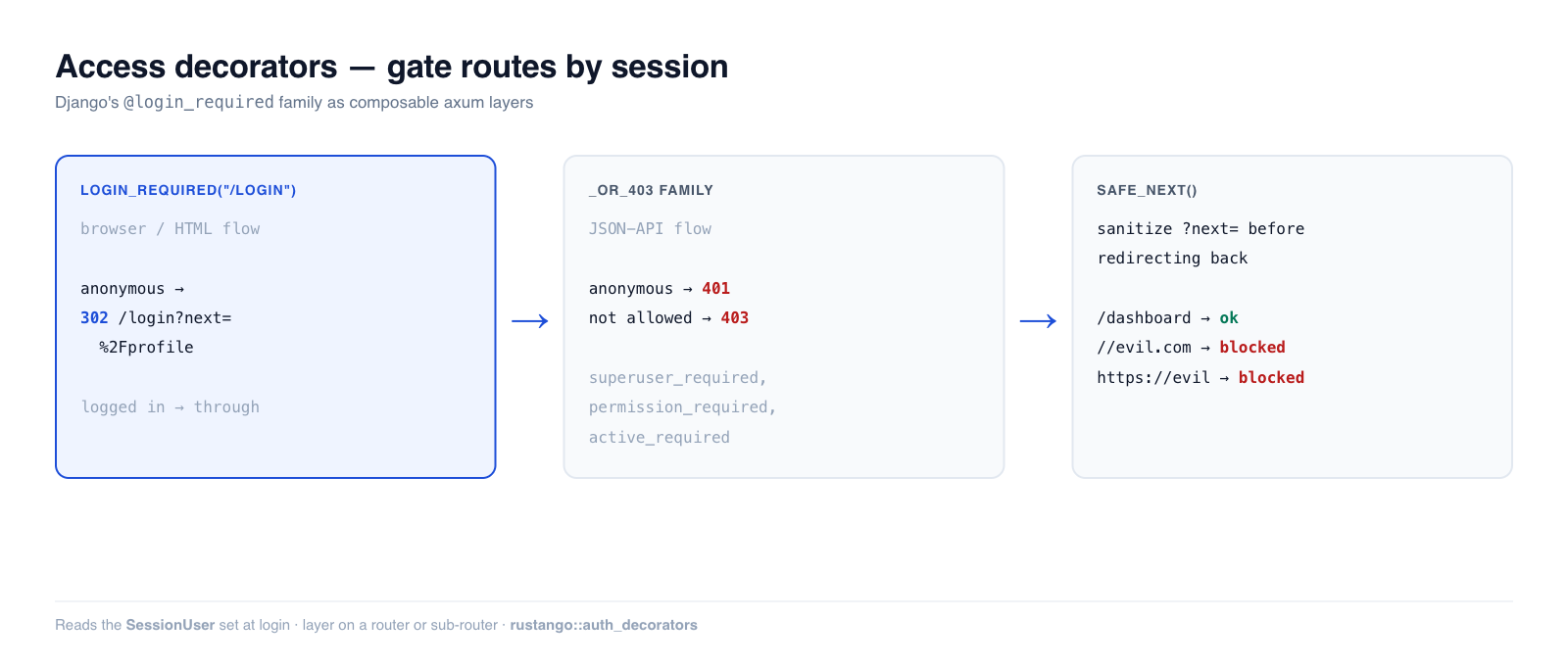
Source:
rustango::auth_decorators(login_required,login_required_or_401,user_passes_test,superuser_required,active_required,permission_required+_or_403variants;safe_next,extract_next) — behind thetenancyfeature (the gates read theSessionUserextractor).Runnable version: the gating behavior is covered by the tested
auth_demo—cargo test -p auth_demo --test auth_decorators.
New to a term here? middleware/layer, extractor, 401/403 — see the glossary.
Deep dive companion to the Security guide. The gates read the session set at login — see Sessions.
Table of contents
- Quick start · Browser vs API gates
- The gate family · Predicate & role gates
- Permission gates · The
?next=round-trip - Notes & limits
Quick start
use rustango::auth_decorators::login_required;

// Scope the gate to a sub-router (the idiomatic shape):
let private = Router::new()
    .route("/profile", get(profile))
    .route("/settings", get(settings))
    .layer(login_required("/login"));      // anonymous → 302 /login?next=...

let app = Router::new()
    .route("/", get(home))                 // public
    .merge(private);
Anonymous requests to /profile are redirected to /login?next=%2Fprofile; an
authenticated request passes through to the handler.
Browser vs API gates
The same gate comes in two response shapes. Pick by what the caller can do with the response:
- Browser / HTML → the base gates 302-redirect to your login page (a human can follow it and log in).
- JSON API → the
_or_403family returns status codes:401 Unauthorizedfor anonymous,403 Forbiddenfor authenticated-but-not-allowed (a client can't render an HTML login page, and the 401/403 split lets it tell "log in" from "you can't do that" apart).
// Browser: redirect to /login
let app = Router::new().route("/dashboard", get(dash)).layer(login_required("/login"));

// API: 401 for anonymous, never a redirect
let api = Router::new().route("/api/me", get(me)).layer(login_required_or_401());
The gate family
| Gate (browser, 302) | API variant (401/403) | Lets through |
|---|---|---|
login_required(url) | login_required_or_401() | any logged-in user |
active_required(url) | active_required_or_403() | logged-in and active |
superuser_required(url) | superuser_required_or_403() | is_superuser && active |
user_passes_test(url, pred) | user_passes_test_or_403(pred) | predicate over the User row |
permission_required(url, codename) | permission_required_or_403(codename) | holds the permission codename |
All are tower layers — .layer(...) them onto a router or sub-router.
Predicate and role gates
user_passes_test runs your closure against the resolved User row, so you can
gate on any field:
use rustango::auth_decorators::{user_passes_test, superuser_required_or_403};

// Staff-only sub-router (browser):
let staff = Router::new()
    .route("/admin/dashboard", get(dashboard))
    .layer(user_passes_test("/login", |u| u.is_superuser));

// Superuser-only JSON API → 401 anonymous / 403 non-superuser:
let api = Router::new()
    .route("/api/admin/stats", get(stats))
    .layer(superuser_required_or_403());
superuser_required / active_required are pinned shortcuts for the common
is_superuser && active / active predicates so call sites don't silently
diverge on whether deactivated accounts still count.
Permission gates
permission_required checks a permission codename against the tenant's
permission engine (superusers bypass automatically). It additionally resolves
the Tenant extractor, so routes using it must be mounted under the tenant
context:
use rustango::auth_decorators::permission_required;
use rustango::tenancy::permissions::ACCESS_ADMIN_CODENAME;

let admin = Router::new()
    .route("/admin", get(dashboard))
    .layer(permission_required("/login", ACCESS_ADMIN_CODENAME));
The ?next= round-trip
login_required preserves the originally-requested URL in ?next= so your login
handler can send the user back after authenticating. You must sanitize that
value — echoing it into a redirect unchecked is a textbook open-redirect
(phishing) hole. safe_next is the guard:
use rustango::auth_decorators::{extract_next, safe_next};

async fn login_post(Query(q): Query<HashMap<String, String>>, /* … */) -> Response {
    // … verify credentials, set the session …
    let dest = extract_next(&q)
        .and_then(|n| safe_next(&n))          // rejects open redirects
        .unwrap_or_else(|| "/".to_owned());
    Redirect::to(&dest).into_response()
}
safe_next only accepts same-origin, root-relative paths — it rejects absolute
URLs, scheme-relative //host, backslash variants, and their percent-encoded
forms:
assert_eq!(safe_next("/dashboard"),            Some("/dashboard".to_owned()));
assert_eq!(safe_next("https://evil.example/x"), None);
assert_eq!(safe_next("//evil.example/x"),       None);   // scheme-relative
assert_eq!(safe_next("%2F%2Fevil.example/x"),   None);   // decodes to //evil
Notes and limits
- These gates read the session. "Logged in" means the
SessionUserextractor resolved a user from the session cookie — so they're for session/cookie auth. API token auth (JWT, API keys) gates at the backend chain layer instead, reading theAuthorizationheader. - Layer ordering matters.
.layer(gate)protects every route added to the router before it; routes added after are public. Scoping the gate to a dedicated sub-router (the quick-start shape) avoids that footgun. permission_requiredneeds tenant context (it queries the tenant perm engine) — mount it under the tenant; an untenant'd route 500s.- The redirect's
?next=is always percent-encoded, so CRLF / response-splitting can't leak into theLocationheader.