 Rustango
 HMAC request signing
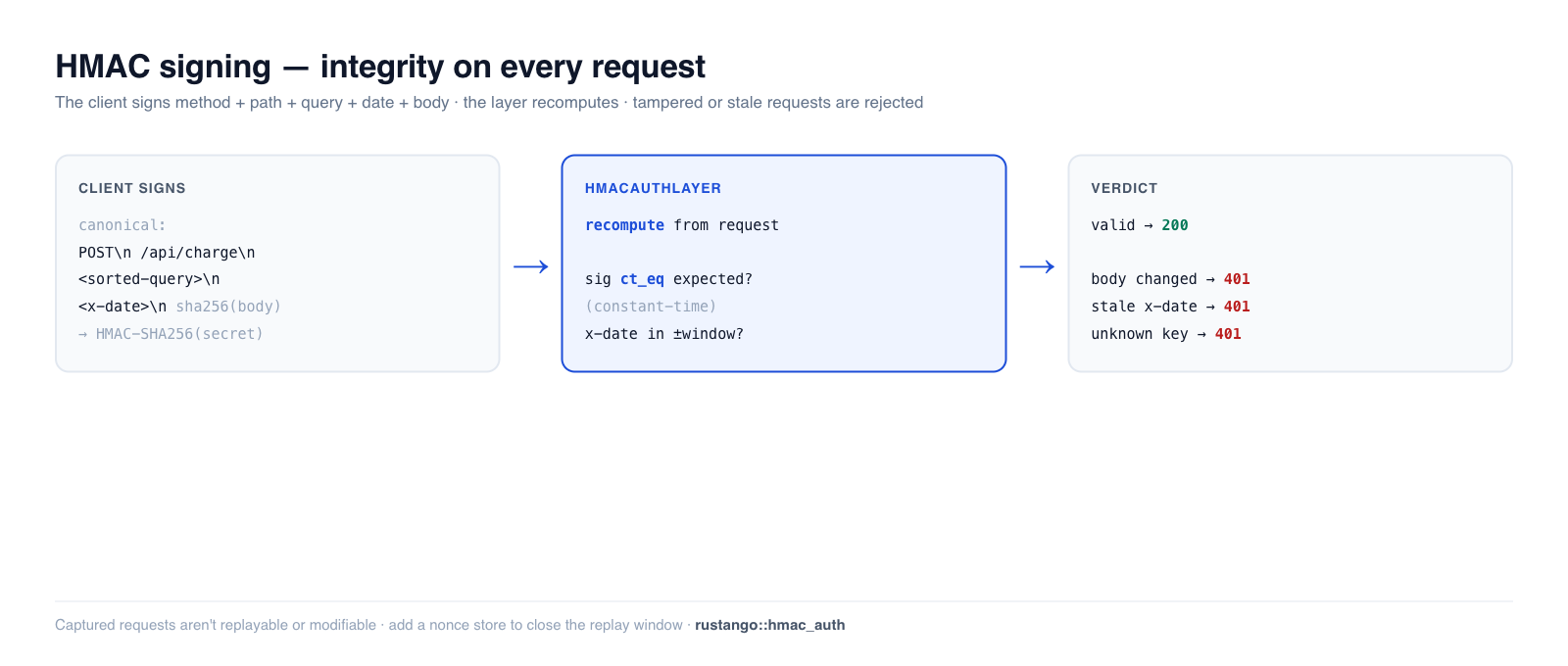
HMAC signing proves both who sent a request and that it wasn't altered in flight. The client signs each request with a shared secret; the server recomputes the signature and compares. Unlike a bearer API key — which is replayable if captured — an HMAC signature covers the method, path, query, timestamp, and body, so a tampered or stale request is rejected. It's the scheme AWS SigV4 and webhook signatures use, and Rustango ships it as one tower layer.
New to a term here? HMAC, shared secret, replay, constant-time compare — see the glossary.
Source:
rustango::hmac_auth(HmacAuthLayer,KeyResolver,sign_now,sign_request) — behind thehmac-authfeature (on by default; replay protection additionally needscache).Runnable version: every snippet is copied from
auth_hmac_doc.rs(cargo test -p rustango --test auth_hmac_doc).
Table of contents
- When to use it
- What gets signed
- Server: verify with the layer
- Client: sign a request
- Clock skew and replay
- Limits
- See also
When to use it
| Use… | When |
|---|---|
| API key (Bearer) | Simple machine auth; capture risk is acceptable (TLS, short rotation). |
| HMAC signing | You need per-request integrity + replay resistance — webhooks, partner APIs, anything where a captured request must not be reusable or modifiable. |
| JWT | Stateless, self-describing user tokens with claims. |
HMAC needs both sides to hold the same secret out-of-band (you provision it), and reasonably synced clocks.
What gets signed
The client builds a canonical string and HMAC-SHA256s it with the shared secret:
<UPPERCASE-METHOD>\n
<PATH>\n
<SORTED-QUERY>\n
<X-DATE>\n
<HEX-SHA256(BODY)>
Two request headers carry the result:
X-Date— an RFC 3339 timestamp (also part of the signed string).Authorization: HMAC-SHA256 keyId=<id>,signature=<base64>
Because the query is sorted on both ends, ?b=2&a=1 and ?a=1&b=2 produce
the same signature. Because the body is hashed into the string, changing a single
byte invalidates it.
Server: verify with the layer
HmacAuthLayer::new takes a KeyResolver — a closure mapping a keyId to
its secret (None ⇒ unknown key ⇒ 401). Attach it as a normal tower layer in
front of the routes you want to protect:
use std::sync::Arc;
use rustango::hmac_auth::{HmacAuthLayer, KeyResolver};
use tower::Layer;

// Resolve key ids to secrets — back this with your DB / secret store.
let resolver: KeyResolver = Arc::new(|key_id: &str| {
    (key_id == "k_demo").then(|| b"shared-secret-at-least-32-bytes-long!!".to_vec())
});

let layer = HmacAuthLayer::new(resolver)
    .tolerance_secs(300);                 // ±5 min clock-skew window (default)

let app = protected_router.layer(layer);
A correctly-signed request passes; tamper with the body, drop X-Date, or sign
with an unknown key and it's a 401:
// correctly signed            → 200
// body changed after signing  → 401  (signature mismatch)
// missing X-Date header       → 401
// keyId the resolver rejects  → 401
No identity extractor. The layer verifies the signature but does not inject which
keyIdsigned into the request — there's noHmacUserextractor. If a handler needs the caller identity, wrap the layer or carry it yourself. Rejections are plain401/413responses, not a typed error you match on.
Client: sign a request
sign_now signs with the current time and returns the two header values to
attach (sign_request is the variant that takes an explicit RFC 3339 date):
use rustango::hmac_auth::sign_now;

let body = br#"{"amount": 100}"#;
let (x_date, authorization) =
    sign_now("k_demo", b"shared-secret-at-least-32-bytes-long!!",
             "POST", "/api/charge", "", body);

// Attach both headers and send the EXACT body you signed:
let req = http::Request::post("/api/charge")
    .header("x-date", x_date)
    .header("authorization", authorization)
    .body(body.to_vec())?;
The signature is base64; the body-hash inside the canonical string is hex. Send the body byte-for-byte as signed — any proxy that rewrites it (recompression, JSON re-serialization) breaks verification.
Clock skew and replay
The X-Date timestamp bounds replay: a request whose date is outside
tolerance_secs (default ±300 s) is rejected, so a captured request is only
reusable inside that short window. To close it entirely, attach a nonce store
(any cache::Cache) and each signature can be spent only once within the window:
use rustango::cache::InMemoryCache;

let layer = HmacAuthLayer::new(resolver)
    .tolerance_secs(120)
    .nonce_store(Arc::new(InMemoryCache::new()));  // reject replays
In production use a shared store (Redis) so the protection holds across replicas — an in-process cache only guards one instance. The replay check fails open on a cache error (availability over the narrow in-window risk).
Limits
- Symmetric ±skew, RFC 3339 dates. Both clocks must be roughly synced; the
client must send the same timestamp it signed (
sign_nowreturns it for you). - Full body buffering. The body is read into memory to hash it (default cap
10 MiB →
413; raise with.body_limit(n)but mind memory). Streaming bodies aren't supported. - Signature is base64 on the wire, body-hash is hex — easy to mix up when writing a client in another language.
- Keep the layer outermost relative to anything that mutates the body.
See also
- API keys — simpler bearer credential when integrity/replay aren't a concern.
- Auth backends — for identifying a user per request (HMAC proves message integrity, not a session identity).
- Webhooks — the inbound counterpart: verifying signatures on events you receive.
- Middleware — how tower layers attach and order.