 Rustango
 Auth backends
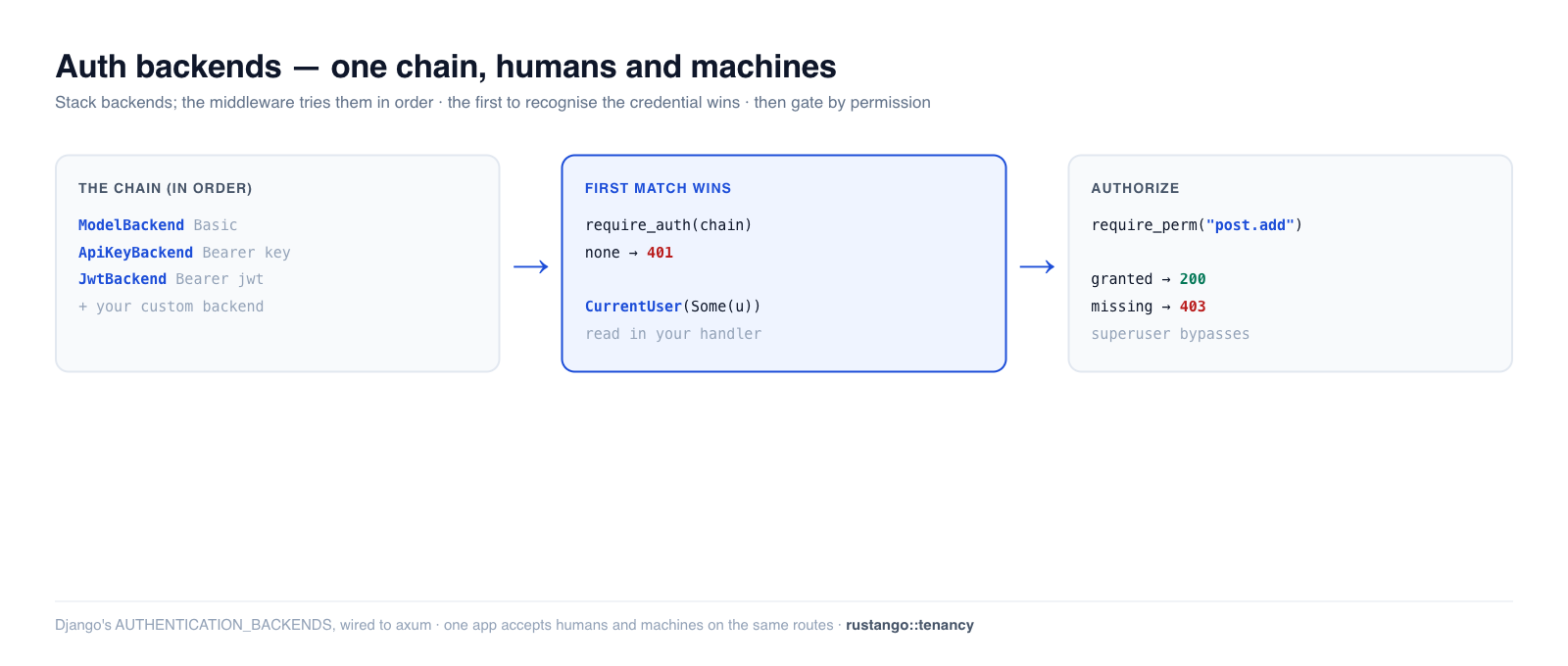
An auth backend answers one question: given an incoming request, who is the
user? Rustango lets you stack several — HTTP Basic, API key, JWT — into a
chain that the auth middleware tries in order, so one app can accept humans and
machines on the same routes. You pick which backends to register and in what
order, and the chain is wired to axum. Pair it with require_auth /
require_perm to gate routes and the CurrentUser extractor to read the
result.
New to a term here? Backend, middleware, extractor, permission codename — see the glossary.
Source:
rustango::tenancy::auth_backends(AuthBackend,ModelBackend,ApiKeyBackend,JwtBackend,AuthUser,AuthError) andrustango::tenancy::{RouterAuthExt, CurrentUser}— behind thetenancyfeature. A portable, DB-agnostic registry also lives atrustango::auth_backends, which needs the internal_async_traitfeature — pulled in bycache,jobsandoauth2, so most builds have it, but a minimal one does not.Runnable version: every snippet is copied from
auth_backends_doc.rs(cargo test -p rustango --features sqlite,tenancy --test auth_backends_doc).
Table of contents
- The chain · The built-in backends
- Gating routes: require_auth
- Reading the user: CurrentUser
- Permissions: require_perm
- The portable registry
- See also
The chain
You hand require_auth a Vec<Arc<dyn AuthBackend>>. On each request the
middleware tries them in order:
- the first backend that recognises the credential wins (returns the user);
- a backend that doesn't recognise it returns "none" and the next is tried;
- if a backend hard-errors (e.g. an inactive account on a valid token) the chain stops with that error;
- if none match, the request is
401(withrequire_auth) or proceeds anonymously (withoptional_auth).
use std::sync::Arc;
use rustango::tenancy::auth_backends::{ApiKeyBackend, AuthBackend, ModelBackend};

let backends: Vec<Arc<dyn AuthBackend>> = vec![
    Arc::new(ModelBackend),    // HTTP Basic  → humans
    Arc::new(ApiKeyBackend),   // Bearer key  → machines
];
The built-in backends
| Backend | Credential it reads | Identifies a user by |
|---|---|---|
ModelBackend | Authorization: Basic <base64(user:pass)> | username + argon2id password verify against rustango_users |
ApiKeyBackend | Authorization: Bearer <prefix.secret> | the rustango_api_keys table (see API keys) |
JwtBackend | Authorization: Bearer <jwt> | a signed HS256 token (see JWT) |
ApiKeyBackend and JwtBackend both read Bearer and disambiguate by shape (an
API key's first dot-segment is exactly 8 chars). Construct JwtBackend with a
secret of at least 32 bytes (JwtBackend::new(secret) panics otherwise):
use rustango::tenancy::auth_backends::JwtBackend;

let backends: Vec<Arc<dyn AuthBackend>> = vec![
    Arc::new(ModelBackend),
    Arc::new(JwtBackend::new(jwt_secret_at_least_32_bytes.to_vec())),
];
On a tenant route the token's tenant claim must match the resolved tenant, and
MCP agent tokens (kind claim) are refused. Mint with JwtAuth login or
JwtBackend::issue_for_tenant; plain issue tokens work only where no tenant is resolved.
JwtBackend accepts the access tokens JwtLifecycle issues, and refuses its
refresh tokens — the two are wire-identical apart from typ, so a refresh
token presented as a bearer would otherwise be an access credential with days
of life instead of minutes.
Revocation is opt-in and off by default. A bare JwtBackend never consults
a blacklist, so a token revoked by /api/auth/logout keeps authenticating
through this backend until it expires on its own. Share one store between the
lifecycle and the backend to make logout take effect:
use rustango::jti_store::{InMemoryJtiStore, JtiStore};

let shared: Arc<dyn JtiStore> = Arc::new(InMemoryJtiStore::new()); // Redis in prod
let lifecycle = JwtLifecycle::new(secret.clone()).with_jti_store(Arc::clone(&shared));
let backend = JwtBackend::new(secret).with_jti_store(Arc::clone(&shared));
It must be the same store. Wiring two instances looks configured and enforces nothing: logout writes to one and verification reads the other. See revocation and the JTI store.
Write a custom backend by implementing the trait (one async method that inspects
the request Parts and returns Option<AuthUser>):
use async_trait::async_trait;   // add `async-trait` to your Cargo.toml
use axum::http::request::Parts;
use rustango::sql::Pool;
use rustango::tenancy::auth_backends::{AuthBackend, AuthError, AuthUser};

struct HeaderBackend;

#[async_trait]
impl AuthBackend for HeaderBackend {
    async fn authenticate(&self, parts: &Parts, _pool: &Pool)
        -> Result<Option<AuthUser>, AuthError>
    {
        // ...inspect parts.headers, return Some(AuthUser{..}) or Ok(None)
        Ok(None)
    }
}
Gating routes: require_auth
RouterAuthExt adds the middleware. require_auth rejects anonymous requests
with 401; optional_auth lets them through (so a handler can branch on
logged-in vs not):
use rustango::tenancy::RouterAuthExt;

let app = Router::new()
    .route("/profile", get(profile))
    .require_auth(backends);           // 401 if no backend matches
These took a
Poolbefore 0.57.11. They do not any more, and the change is a security fix, not tidying. The pool was captured when the router was built and reused for every request, so a credential issued by one tenant authenticated on another tenant's host — the backends looked the user up in whichever database the router happened to be constructed with, andis_superusertravelled onward in a request extension without a re-query.The pool now comes from the tenant resolved for each request. Migration is dropping the argument:
.require_auth(backends, pool.clone())  →  .require_auth(backends)
.require_perm("post.add", pool)        →  .require_perm("post.add")
Mount the tenancy layer outside these. Without a tenant context in request extensions they fail closed with a
500rather than guess a database.
Verified behaviour:
// no credentials               → 401
// Basic alice:<correct>        → 200
// Basic alice:<wrong>          → 401   (no backend accepted; no enumeration)
// Bearer <valid api key>       → 200
Reading the user: CurrentUser
Handlers read the authenticated user with the CurrentUser extractor. It's
infallible — Some(user) when a backend resolved one, None otherwise:
use rustango::tenancy::CurrentUser;

async fn profile(CurrentUser(user): CurrentUser) -> Response {
    match user {
        Some(u) => format!("hello {}", u.username).into_response(),
        None    => StatusCode::UNAUTHORIZED.into_response(),
    }
}
Foot-gun: because
CurrentUseris infallible, forgettingrequire_authdoesn't fail to compile — every request just seesNone. Behindrequire_auth, anonymous requests are already401'd, souseris alwaysSomethere.
Permissions: require_perm
require_perm gates a route on a permission codename ({table}.{action},
e.g. post.add). Apply it to the inner sub-router and require_auth to the
outer one, so the user is resolved before the permission is checked:
let admin = Router::new()
    .route("/admin", get(admin_only))
    .require_perm("post.add");     // inner: needs the codename

let app = Router::new()
    .route("/profile", get(profile))
    .merge(admin)
    .require_auth(backends);       // outer: resolves the user first
// alice (granted post.add)   → /admin 200
// bob   (authed, no grant)   → /admin 403
// anonymous                  → /admin 401   (auth runs first)
Resolution: a superuser (active) passes everything; a deactivated user
is denied even with grants; an explicit per-user override wins over role grants;
otherwise any role the user holds that grants the codename passes. Grant with
set_user_perm_pool / roles via create_role_pool + assign_role_pool (the
permission tables are created by ensure_tables_pool).
The portable registry
Separately, rustango::auth_backends (note: crate root, not tenancy) is a
small framework-agnostic registry — a Credentials → Principal chain with
its own AuthBackend trait. It has no HTTP/axum glue; use it when you want
pluggable auth backends inside your own auth code:
use std::sync::Arc;
use rustango::auth_backends::{
    AuthBackendChain, AuthError, Credentials, Principal, RemoteUserBackend,
};

async fn who(remote_user: &str) -> Result<Option<Principal>, AuthError> {
    let chain = AuthBackendChain::new().with(Arc::new(RemoteUserBackend::trust_username()));
    chain.authenticate(&Credentials::remote(remote_user)).await
}
Same "first success wins / first error stops" semantics as the HTTP chain. For
gating real routes, use the tenancy middleware above.
See also
- API keys and JWT — the credentials
ApiKeyBackend/JwtBackendconsume. - Passwords — the hashing
ModelBackendverifies against. - Access decorators — per-handler
login_required/permission_requiredgating, the decorator-style alternative torequire_auth/require_perm. - Sessions — cookie-based auth for browsers.