 Rustango
 ORM cookbook
Patterns for the Rustango ORM beyond the basics. If you come from Django's ORM, Laravel Eloquent, or Rails ActiveRecord, the shapes here will feel familiar. Most examples assume you already have a Post model from Getting Started.
Source:
rustango::sql(QuerySet, theQ!macro /Qbbuilder) and the#[derive(Model)]query API — always compiled; pick a backend feature (postgres/mysql/sqlite).Runnable version: the patterns here run in the tested
orm_cookbookexample.New to a term here? The glossary defines model, queryset, pool, and migration in plain language.
A few Rust terms recur throughout. &pool is a shared reference to the database connection pool; you pass it to the methods that actually run SQL. .await runs an async call and waits for the result. Option<T> is a value that may be present (Some) or absent (None) — Rust's null. Result is success-or-error; the trailing ? on a call returns early on error. Auto<i64> is an auto-incrementing primary key that's either Set (loaded from the DB) or Unset (not yet inserted).
What's new (v0.41 / v0.42)
Recent releases added a batch of Django-parity features that aren't yet woven into every section below. Quick pointers:
Q!macro +Qbruntime builder (#269, #263) — compile-time-safe Django-shape filters.User::objects().where_(Q!(User.email__icontains = "alice"))fails to build on a typo'd field name. Runtime-composable variant for admin filter chips:let q = Qb::eq("active", true) & Qb::gt("age", 18i64);..distinct_on(&["author_id"])(#264) — PG native; portable window-function fallback on MySQL / SQLite. "Latest per group" patterns.bulk_upsert_pool(rows, unique_fields, update_fields, &pool)(#267) — Djangobulk_create(update_conflicts=True). Tri-dialect ON CONFLICT / ON DUPLICATE KEY UPDATE.explain_pool()(#272) — tri-dialect EXPLAIN. PGEXPLAIN (FORMAT JSON, ANALYZE, BUFFERS)/ MySQLEXPLAIN ANALYZE/ SQLiteEXPLAIN QUERY PLAN.- DB function library (#266) —
Cast,LPad,RPad,MD5,SHA1,SHA256,Position,Repeat,Reverse,Sign,Mod,Power,Sqrt. Per-dialect emission with clear errors where SQLite lacks the function. - Field types —
rust_decimal::Decimal(PG/MySQL native, SQLite via Decode shim),chrono::NaiveTime,Vec<u8>(FieldType::Binary) now accepted by#[derive(Model)](#524, v0.42). ModelForm::prepare_save()/PreparedSave(#375, v0.42) — Djangosave(commit=False). Validate now, mutate the prepared write set, commit when ready.#[rustango(unique_when(columns = "...", condition = "..."))](#265) — partial unique constraints. "Unique email per non-deleted row" / "Unique slug per tenant".#[rustango(manager(ext = "FooManagerExt"))](#271) — Django-shape custom-manager extension trait emitted next to the model. (Also the Rust shape of Django proxy models — same physical table, multiple "personalities" via per-trait methods. Seeinheritance.rs:98-127.)manage makemigrations --merge(#346, v0.42) — Django-shape merge node for divergent branch chains. Seedocs/manage.md.
The CHANGELOG carries the full ticket index for each release.
Table of contents
- Querying
- Computed values & database functions
- Aggregations
- Joins & preloading related rows
- Bulk operations
- Insert or update (upsert)
- Transactions
- Many-to-many
- JSON / JSONB
- Soft delete
- Audit trail
- Raw SQL escape hatch
- Lazy FK loading
- Four ways to filter
- Tenant-scoped queries
- Signals
- Performance tips
Querying
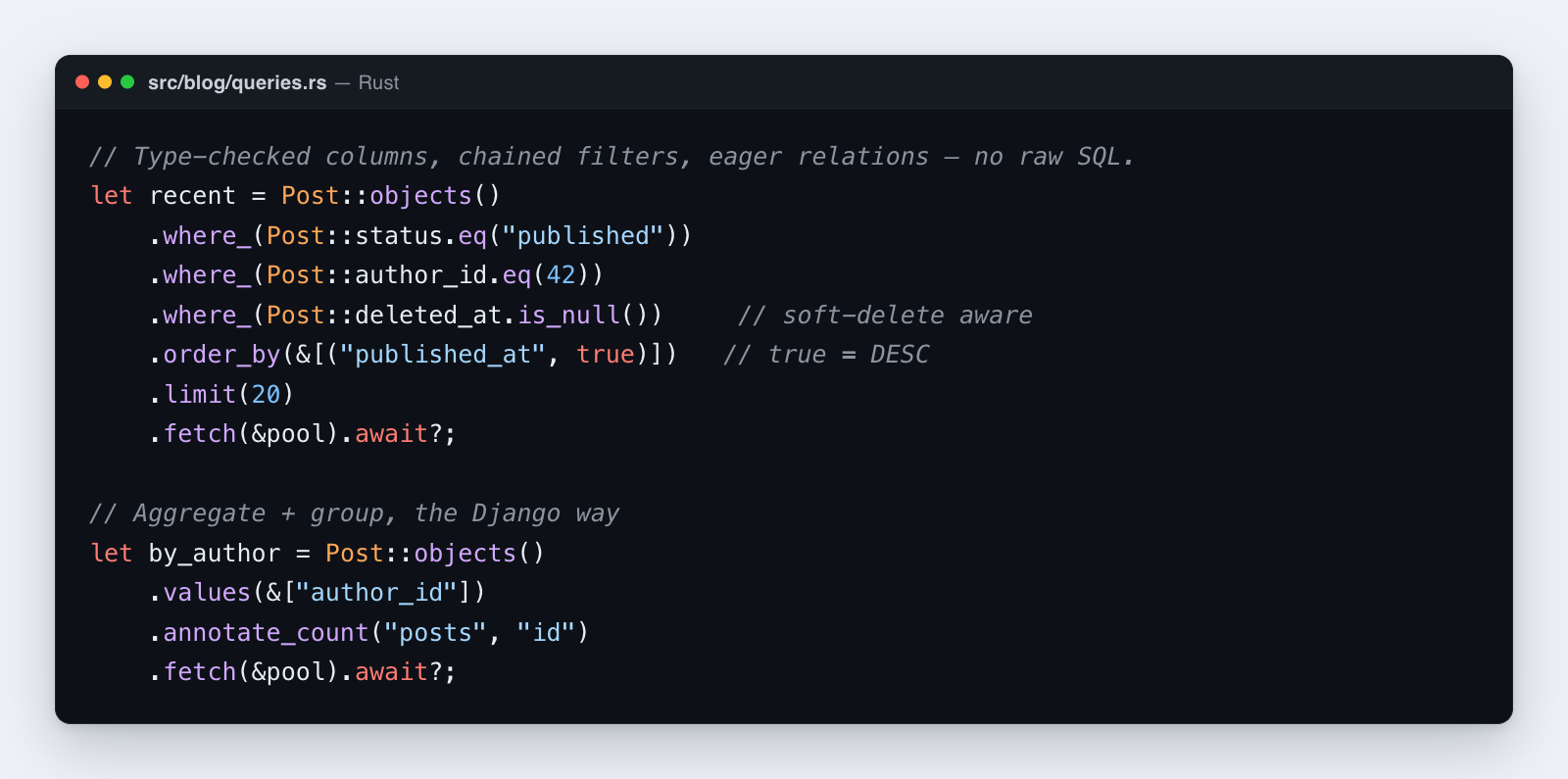
Read rows from the database. Post::objects() starts a query (like Django's Post.objects); you chain filters and ordering, then call .fetch(&pool).await? to run it and get back a Vec<Post>. .where_(...) adds an AND-joined condition.
use rustango::core::Column as _;
use rustango::core::{Op, SqlValue, WhereExpr};   // for filter_op / where_raw below
use rustango::sql::FetcherPool as _;

// Simplest — fetch all
let posts = Post::objects().fetch(&pool).await?;

// Single equality filter
let drafts = Post::objects()
    .where_(Post::status.eq("draft"))
    .fetch(&pool).await?;

// Chained filters (AND)
let recent_drafts = Post::objects()
    .where_(Post::status.eq("draft"))
    .where_(Post::author_id.eq(42))
    .where_(Post::deleted_at.is_null())
    .order_by(&[("created_at", true)])        // true = DESC
    .limit(20)
    .fetch(&pool).await?;

// String-keyed filter (validated at compile of the queryset)
let by_id = Post::objects()
    .filter_op("id", Op::Eq, SqlValue::I64(42))
    .fetch(&pool).await?;

// OR / nested
let qs = Post::objects().where_raw(WhereExpr::Or(vec![
    Post::status.eq("draft").into(),
    Post::status.eq("review").into(),
]));

// XOR — Django 4.1+ `Q(a) ^ Q(b)`. Matches rows where an odd number
// of operands evaluate to true (binary case = "exactly one is true").
// Issue #27.
let either_but_not_both = Post::objects()
    .where_(Post::status.eq("draft").xor(Post::author_id.eq(42)))
    .fetch(&pool).await?;
// Tri-dialect emission: native logical XOR exists on MySQL but not PG
// or SQLite, so the writer emits a portable rewrite uniformly —
// `(a AND NOT b) OR (NOT a AND b)` for the binary form, or a
// CASE-WHEN-1/0 tally `% 2 = 1` for N-ary chains.
Comparison filters
The everyday filter methods, one per SQL operator. These are Django's field lookups (__gt, __in, __icontains, and so on) in typed form.
Post::objects().where_(Post::view_count.gt(100)).fetch(&pool).await?;
Post::objects().where_(Post::view_count.gte(100)).fetch(&pool).await?;
Post::objects().where_(Post::view_count.lt(100)).fetch(&pool).await?;
Post::objects().where_(Post::view_count.lte(100)).fetch(&pool).await?;
Post::objects().where_(Post::status.ne("archived")).fetch(&pool).await?;
Post::objects().where_(Post::id.is_in([1, 2, 3])).fetch(&pool).await?;
Post::objects().where_(Post::status.not_in(["draft", "deleted"])).fetch(&pool).await?;
Post::objects().where_(Post::title.like("%draft%")).fetch(&pool).await?;          // case-sensitive contains
Post::objects().where_(Post::title.ilike("%draft%")).fetch(&pool).await?;         // case-insensitive contains
Post::objects().where_(Post::title.ilike("Hello%")).fetch(&pool).await?;          // case-insensitive starts-with
Post::objects().where_(Post::deleted_at.is_null()).fetch(&pool).await?;
Post::objects().where_(Post::published_at.between(start, end)).fetch(&pool).await?;
Sorting results
Sort rows by one or more columns, by an expression, or with explicit control over where NULLs land. Beyond the basic .order_by(&[("col", desc)]), you get three extra dimensions:
use rustango::core::funcs::lower;
use rustango::core::{F, NullsOrder};

// 1. Plain field + ASC/DESC (back-compat — implicit NULLS handling
//    differs between dialects; see the dialect note below).
Post::objects()
    .order_by(&[("published_at", true), ("id", false)])
    .fetch(&pool).await?;

// 2. Explicit NULLS FIRST/LAST control — portable across PG, MySQL,
//    and SQLite. MySQL has no native `NULLS …` keyword; the writer
//    emulates with an `<col> IS NULL` pre-sort term so the on-wire
//    ordering matches PG/SQLite.
Post::objects()
    .order_by_with_nulls(&[("score", true, NullsOrder::Last)])
    .fetch(&pool).await?;

// 3. Arbitrary Expr in the ORDER BY position — case-insensitive
//    title sort via `LOWER(title)`, computed sort keys via
//    `case() / when() / value()`, arithmetic via `F("a") + F("b")`.
Post::objects()
    .order_by_expr(lower(F("title")), false)
    .order_by_expr_with_nulls(F("score") + 1_i64, true, NullsOrder::Last)
    .fetch(&pool).await?;
Per-dialect NULLS handling (no explicit NullsOrder set):
| Dialect | ASC default | DESC default |
|---|---|---|
| PostgreSQL | NULLS LAST | NULLS FIRST |
| SQLite | NULLS LAST | NULLS FIRST |
| MySQL | NULLs first (smallest-value semantics) | NULLs last |
Use .order_by_with_nulls(...) / .order_by_expr_with_nulls(...) to pin the placement; otherwise the database's native default applies. On MySQL the writer emits <col> IS NULL <asc|desc> ahead of the actual sort to emulate; the emitted SQL has two ORDER BY terms per pinned column but the semantic matches PG/SQLite.
Chain composition. .order_by(...), .order_by_with_nulls(...), and .order_by_expr(...) accumulate into one unified list in registration order. .replace_order_by(&[...]) clears every prior order-by call. .flip_order_by() inverts every direction AND swaps NullsOrder::First ↔ NullsOrder::Last so the "NULLs at the same end" semantic survives an inversion (for explicit First / Last; the dialect-default behavior under Default still tracks direction).
Random ordering
Return rows in random order — Django's .order_by('?'). Use .order_random(). It emits ORDER BY RANDOM() on PG and SQLite, ORDER BY RAND() on MySQL. Handy for banner rotation, sampling, or A/B-test bucket assignment without pulling rows into the app to shuffle them.
// Three random posts.
Post::objects()
    .order_random()
    .limit(3)
    .fetch(&pool).await?;

// Random tie-breaker after a primary sort: posts ordered by score
// descending, with ties shuffled.
Post::objects()
    .order_by(&[("score", true)])
    .order_random()
    .fetch(&pool).await?;
The IR variant carries no direction or NULLS clause: random ordering is unordered by definition, and the random key is computed per row (non-NULL).
Performance caveat. ORDER BY RANDOM() forces a full table scan + in-memory sort by a per-row random key. The query planner can't use an index. For tables much larger than memory, prefer the index-friendly pattern:
// Coin-flip offset; range-scans the PK index.
let max_id: i64 = Post::objects().max::<i64>("id", &pool).await?.unwrap_or(0);
let offset = rand::random::<u32>() as i64 % max_id.max(1);
Post::objects()
    .where_(Post::id.gte(offset))
    .order_by(&[("id", false)])
    .limit(1)
    .fetch(&pool).await?;
The trade-off: adjacency in the result rows mirrors PK adjacency, so it's not "uniformly random" in the strict sense — but it's free of the full-table-scan cost.
Pagination
Fetch one page of results at a time. .limit(size).offset(...) is the simple page-number form; the cursor form ("everything after the last id I saw") scales better on large tables.
// Page-number — page 2 of 50-row pages = LIMIT 50 OFFSET 50.
let page = Post::objects().limit(50).offset(50).fetch(&pool).await?;

// Cursor (manual — no auto-next-token from QuerySet)
let next = Post::objects()
    .where_(Post::id.gt(last_id))
    .order_by(&[("id", false)])
    .limit(50)
    .fetch(&pool).await?;
For HTTP-side cursor pagination, use ViewSet::cursor_pagination("id") instead.
Fetching rows into a map
Look up many rows by a list of values and get them back as a HashMap keyed by that column. This is Django's in_bulk(ids, field_name=). Use .in_bulk(...) for "fetch these N rows in one round trip, indexed by id." A HashMap<K, V> is Rust's dictionary/hash table.
use std::collections::HashMap;
use rustango::sql::Auto;

// Default Django shape: keyed by the Auto<i64> PK.
let books: HashMap<i64, Book> = Book::objects()
    .in_bulk(Book::id, [1_i64, 2, 3], |b| match b.id {
        Auto::Set(v) => v,
        Auto::Unset  => unreachable!("fetched row has Auto::Set PK"),
    }, &pool)
    .await?;
assert_eq!(books[&1].title, "The Rust Programming Language");

// `field_name=` equivalent — key by any unique column.
let by_isbn: HashMap<String, Book> = Book::objects()
    .in_bulk(Book::isbn, ["isbn-1".to_string()], |b| b.isbn.clone(), &pool)
    .await?;
Composes with prior .where_() filters — the IN-list AND-joins with the existing WHERE. Empty ids short-circuits with an empty map (no SQL is issued). The closure handles Auto<T> / ForeignKey<T, K> unwrap explicitly, giving callers control over how the key materializes.
Tenant-scoped sibling: in_bulk_on(column, ids, extract, &executor) takes any sqlx executor — pair with tenant.conn() for schema-mode tenants.
Locking rows for update
Lock the rows you select so no other transaction can change them until you commit — the standard way to claim work or prevent lost updates. This is Django's select_for_update(skip_locked=, nowait=, of=, no_key=). Call .select_for_update(); it appends SELECT … FOR UPDATE (or a variant) and the lock lasts for the surrounding transaction.
// Canonical "claim next available row" pattern. Worker A grabs the
// lowest-priority pending job; concurrent worker B with SKIP LOCKED
// skips A's row and grabs the next instead — no blocking.
let mut tx = pool.begin().await?;
let claim: Vec<Job> = Job::objects()
    .where_(Job::status.eq("pending"))
    .order_by(&[("priority", false)])
    .limit(1)
    .select_for_update()
    .skip_locked()
    .fetch_on(&mut *tx).await?;
// ... mark claim[0] as in-progress, do work ...
tx.commit().await?;
Builder methods — chain to opt in:
.select_for_update()— plainFOR UPDATE..skip_locked()— appendSKIP LOCKED; rows held by another tx are silently filtered out instead of blocking..nowait()— appendNOWAIT; surface a driver error immediately if any matching row is locked. Mutually exclusive withskip_locked(writer picks the more permissiveSKIP LOCKEDif both are set)..no_key()— emitFOR NO KEY UPDATEinstead (PG 9.3+). Weaker lock that doesn't block writers touching only non-key columns..of(&["table_or_alias", …])— restrict the lock to specific tables when the query JOINs.
Calling .skip_locked() / .nowait() / .no_key() / .of(…) without a prior .select_for_update() implicitly enables the lock, matching Django's ergonomics.
Tri-dialect behaviour:
| Dialect | Behaviour |
|---|---|
| PostgreSQL | Full support — every flag emits its native syntax. |
| MySQL 8.0.1+ | Supports everything except NO KEY — that flag falls back to plain FOR UPDATE (the stricter lock). |
| SQLite | No row-level lock syntax. The writer emits no clause at all; transactions hold an implicit write lock for the whole database. Use a different strategy for SQLite (typically a busy-wait loop on the transaction itself). |
Must run inside a transaction. FOR UPDATE outside a tx is a no-op on PostgreSQL (the implicit single-statement tx releases the lock immediately) and an error on MySQL. Pair with pool.begin() (or rustango::sql::atomic).
Combining queries (union, intersection, difference)
Merge two or more queries over the same model with SQL set operators. These are Django's .union(), .intersection(), and .difference().
// Posts that are EITHER drafts OR currently in review.
let inbox: Vec<Post> = Post::objects()
    .where_(Post::status.eq("draft"))
    .union(Post::objects().where_(Post::status.eq("review")))
    .order_by(&[("created_at", true)])
    .limit(50)
    .fetch(&pool).await?;
Builder methods:
| Method | SQL | Semantic |
|---|---|---|
.union(other) | UNION | Combine + deduplicate |
.union_all(other) | UNION ALL | Combine, keep duplicates (cheaper, no DISTINCT pass) |
.intersection(other) | INTERSECT | Rows in BOTH querysets |
.difference(other) | EXCEPT | Rows in first queryset but NOT others |
Every method takes QuerySet<T> — both branches must target the same model T, so the column shape matches by construction (verified at compile time by Rust's generics). Calls accumulate; mixing operators in one chain is allowed (a.union(b).intersection(c) evaluates left-to-right per SQL standard).
Outer modifiers apply to the merged result:
// Outer .order_by() / .limit() / .offset() / .select_for_update()
// set AFTER the union apply to the combined resultset, NOT per-branch.
let page: Vec<Post> = qs_a
    .union(qs_b)
    .union(qs_c)
    .order_by(&[("id", false)])    // sorts the merged rows
    .limit(20)                     // caps the merged count
    .offset(40)                    // skips into the merged result
    .fetch(&pool).await?;

// Per-branch ORDER BY / LIMIT stay INSIDE the branch's parens:
let mixed = qs_a
    .union(qs_b.order_by(&[("id", true)]).limit(5))   // branch picks its top 5
    .fetch(&pool).await?;
Tri-dialect: PostgreSQL + SQLite support all four operators on every version Rustango supports. MySQL 8.0+ supports UNION/UNION ALL; INTERSECT/EXCEPT landed in MySQL 8.0.31. Older MySQL versions surface the driver's syntax error at fetch time — there's no client-side gate.
Error path on the typed builder: .union(other_qs) (and .intersection() / .difference()) compiles the branch eagerly and panics if the branch fails to compile (typo'd column, etc.). For fallible composition where the caller wants a Result, compile the branch first and pass it via .with_compound(SetOp::Union, branch) — one generic entry point covers every operator. The panic shape matches Django's: a bad branch is a programmer error, not a runtime data condition.
Streaming large result sets
Process a huge table without loading it all into memory. This is Django's .iterator(chunk_size=2000). Call .iterator(chunk_size); it fetches chunk_size rows at a time (via LIMIT N OFFSET M) and never buffers the whole result set. Reach for it on million-row exports, ETL pipelines, and batch jobs.
// 1. Whole-chunk loop — process N rows at a time.
let mut iter = Post::objects()
    .where_(Post::published.eq(true))
    .order_by(&[("id", false)])
    .iterator(2_000)?;
while let Some(chunk) = iter.next_chunk(&pool).await? {
    for post in chunk { /* … */ }
}

// 2. Row-by-row loop — buffer one chunk internally, yield one row.
let mut iter = Post::objects().order_by(&[("id", false)]).iterator(2_000)?;
while let Some(post) = iter.next_row(&pool).await? {
    /* … */
}
Set an order_by. OFFSET against a query with no stable sort returns unpredictable rows across chunks — typically .order_by(&[("pk", false)]) so each chunk picks up cleanly. The method doesn't enforce ordering (some queries legitimately want no sort, e.g. a one-shot drain), but unsorted iteration is a footgun.
Trade-off vs server-side cursors. This is a simple LIMIT/OFFSET chunker. On a btree-indexed sort column, PostgreSQL scans the first N rows before returning the (N+1)th — so deep pagination is O(n²) total work. For a 10M-row drain this matters; for 100k rows it usually doesn't. The chunker wins on portability (works on all backends with no transaction overhead) and simplicity (no cursor lifecycle management). For truly streaming reads on PG, drop into pool.begin() + raw sqlx::query(...).fetch(&mut *tx) Stream API directly — the extended protocol streams from the server without offset reseek.
Mixing next_chunk and next_row on the same iterator is safe. The internal VecDeque buffer drains in row order before any new DB fetch, so next_chunk after a partial next_row drain yields the remaining buffered rows first, then continues with fresh chunks.
Both .rows_seen() (cumulative count) and .is_exhausted() (post-drain flag) are available for progress reporting and termination checks.
Concurrent-write hazard. Each chunk is a separate query, so rows inserted/deleted between chunks can be skipped or duplicated (the classic OFFSET-pagination "windowing" problem). For read-only / append-only tables — the typical export use case — this isn't a concern. For tables being written concurrently you need a snapshot-isolation transaction so every chunk sees the same view. ChunkedIter takes &Pool, not a &mut Transaction, so the chunker API can't be used inside the tx directly — hand-roll the chunked SELECT against the tx instead:
let mut tx = pool.begin().await?;
sqlx::query("SET TRANSACTION ISOLATION LEVEL REPEATABLE READ")
    .execute(&mut *tx).await?;

// Hand-loop LIMIT/OFFSET chunks against the tx with `.fetch_on(&mut *tx)`,
// so every chunk reads from the same snapshot.
let chunk_size = 2_000_i64;
let mut offset = 0_i64;
loop {
    let rows: Vec<Post> = Post::objects()
        .order_by(&[("id", false)])
        .limit(chunk_size)
        .offset(offset)
        .fetch_on(&mut *tx)
        .await?;
    if rows.is_empty() { break; }
    for post in &rows { /* … */ }
    if (rows.len() as i64) < chunk_size { break; }
    offset += rows.len() as i64;
}
tx.commit().await?;
select_for_update() doesn't propagate across chunks. Row locks held by .select_for_update() are released at the end of each chunk's implicit transaction. There's no chunker-shaped fix: the .iterator() builder takes &Pool, the locking variants need a &mut Transaction, and the two don't compose. For a locked drain you have two paths, each with a trade-off:
- Whole-result
.fetch_on(&mut *tx)— single round trip, fullVec<T>in memory. Fine when the result fits. - Hand-rolled LIMIT/OFFSET inside the tx — same shape as the snapshot-isolation snippet above; chunks stay streamed but you're outside the
ChunkedIterAPI.
A future iterator_on(&mut *tx, chunk_size) companion (issue follow-up) would close this gap. Not in scope for issue #23.
chunk_size must be > 0. Zero or negative values panic. Pick a value that fits your row-size budget (Django's default is 2000; reasonable for narrow rows, lower for wide TEXT/JSONB columns).
Selecting specific columns
Fetch just a few columns instead of whole Post structs — Django's .values('col') and .values_list('col', flat=True). Use these when you only need a couple of columns off a wide table, or when the result feeds dynamic code (templates, CSV export, JSON). You get maps, tuples, or a flat typed list back instead of model instances.
use rustango::core::SqlValue;
use std::collections::HashMap;

// 1. Column-keyed map per row — Django's `.values('id', 'title')`.
let rows: Vec<HashMap<String, SqlValue>> = Post::objects()
    .where_(Post::published.eq(true))
    .order_by(&[("id", false)])
    .values_dict(&["id", "title"])
    .fetch(&pool).await?;

// 2. Ordered tuple per row — Django's `.values_list('id', 'title')`.
//    Cell ordering matches the column-list argument.
let rows: Vec<Vec<SqlValue>> = Post::objects()
    .values_list(&["title", "id"])  // title first, id second
    .fetch(&pool).await?;

// 3. Single-column typed scalar — Django's `.values_list('id', flat=True)`.
//    Returns Vec<U> directly via sqlx's typed scalar path.
let ids: Vec<i64> = Post::objects()
    .where_(Post::published.eq(true))
    .values_list_flat("id")
    .fetch::<i64>(&pool).await?;
Three builders, one IR. All three set SelectQuery::projection to the validated column list — the SQL is identical across the three terminal shapes; only the row-decode differs:
| Builder | SQL shape | Returns |
|---|---|---|
.values_dict(&[cols]) | SELECT col1, col2 FROM … | Vec<HashMap<String, SqlValue>> |
.values_list(&[cols]) | SELECT col1, col2 FROM … | Vec<Vec<SqlValue>> (ordered by cols) |
.values_list_flat(col) | SELECT col FROM … | Vec<U> (typed, via fetch::<U>(...)) |
Works with the rest of the query chain. .where_(), .filter(), .order_by(), .limit(), .offset(), and the set operators (.union() / .intersection() / .difference()) — every method called BEFORE .values_* carries through. The values builders are terminal (nothing chains after them), so set the query shape first, then fetch.
Validation at .compile() / .fetch() time:
- Empty column list (
.values_dict(&[])) → [QueryError::EmptyValuesProjection]. - Typo'd column name (
.values_dict(&["nope"])) → [QueryError::UnknownField].
Tri-dialect: identical projection emission across PG / MySQL / SQLite (only the identifier quoting differs). For .values_list_flat::<U>(...), U must implement sqlx's Decode + Type on every backend the binary targets — common picks (i64, i32, String, bool, f64) work universally.
Why not change the existing .values() to do pure projection? QuerySet::values(cols) already promotes to [AggregateBuilder] for the GROUP BY auto-inference path (issue #75). Renaming would break ~20 existing call sites. The new .values_dict() / .values_list() / .values_list_flat() chain methods sit alongside, leaving the aggregate path untouched. The pre-existing QueryError::ValuesRequiresAggregate error still fires for .values(cols).compile() without a subsequent .annotate(...) — its message now points callers at the new pure-projection methods.
Including or excluding columns
Same idea as the previous section, but in Django's include/exclude shape: .only('id', 'name') keeps only the named columns, .defer('big_field') keeps everything except them. Use these on wide tables where large TEXT / BLOB / JSONB columns make list views expensive to read:
// .only(...) — fetch only the named columns.
let rows: Vec<HashMap<String, SqlValue>> = Post::objects()
    .where_(Post::published.eq(true))
    .only(&["id", "title"])
    .fetch(&pool).await?;

// .defer(...) — fetch everything except the named columns.
// Useful for "list view: skip body / metadata / large JSON".
let rows: Vec<HashMap<String, SqlValue>> = Post::objects()
    .defer(&["body", "raw_html"])
    .fetch(&pool).await?;
Semantics: .only(&[cols]) is a synonym for .values_dict(cols) — same IR, same return shape, separate entry point for Django-shape readability. .defer(&[cols]) computes the complement against the model schema (every scalar column on the model EXCEPT the listed ones) and routes to the same path.
Caveat — return type differs from Django. Django's .only() / .defer() return partially-hydrated Model instances where the deferred fields lazy-load on attribute access. Rustango has no equivalent of Python's descriptor magic; the return shape is Vec<HashMap<String, SqlValue>> (or Vec<Vec<SqlValue>> if you swap in .values_list(...) instead). Typed partial-row decode is queued for a future slice.
Typo-safety: .defer(&["nope_col"]) surfaces QueryError::UnknownField at .compile() time — the typo doesn't silently turn into "project all columns." .only(&[]) surfaces QueryError::EmptyValuesProjection; .defer(&[]) is a semantic no-op (projects every column).
Matching with regular expressions
Match a column against a regex pattern — Django's __regex / __iregex. .regex() is case-sensitive, .iregex() case-insensitive, and .not_regex() / .not_iregex() are the negated forms.
use rustango::core::Column as _;

// Names starting with "al" (case-sensitive).
User::objects()
    .where_(User::name.regex("^al.*"))
    .fetch(&pool).await?;

// Names starting with "al" — case-insensitive.
User::objects()
    .where_(User::name.iregex("^al.*"))
    .fetch(&pool).await?;

// Negated: exclude names starting with "admin" (case-sensitive).
User::objects()
    .where_(User::name.not_regex("^admin"))
    .fetch(&pool).await?;

// Django-shape lookup-suffix form.
User::objects()
    .filter("name__iregex", "^bob")
    .fetch(&pool).await?;
Tri-dialect emission:
| Dialect | Case-sensitive | Case-insensitive | Notes |
|---|---|---|---|
| PostgreSQL | <col> ~ ? / <col> !~ ? | <col> ~* ? / <col> !~* ? | Native POSIX operators |
| MySQL | `col` REGEXP ? / `col` NOT REGEXP ? | LOWER(col) REGEXP LOWER(?) (negated wraps NOT) | LOWER() fallback for i* |
| SQLite | "col" REGEXP ? / "col" NOT REGEXP ? | LOWER("col") REGEXP LOWER(?) (negated wraps NOT) | Needs the regexp user-function loaded on the connection |
SQLite requires a registered regexp user-function — it's not built in. sqlx-sqlite 0.8 does not register one by default. Two paths to enable it:
- Easy — enable sqlx-sqlite's
regexpcargo feature, then opt the connection in:use sqlx::sqlite::SqliteConnectOptions; let opts = SqliteConnectOptions::new() .filename("app.db") .with_regexp(); // gated on sqlx-sqlite/regexp - Manual — register a Rust closure via
SqliteConnection::lock_handle()+ raw FFI (sqlite3_create_function_v2).
Without one, the query emits valid REGEXP SQL that SQLite rejects at execution with no such function: regexp (parser-clean — tests/regex_sqlite_live.rs pins this).
Pattern dialect differs across backends. PostgreSQL uses POSIX extended regex; MySQL uses ICU-based regex with its own flavor; SQLite delegates to whatever the user-function implements (typically Rust's regex crate). Patterns that lean on dialect-specific syntax (e.g. PG's \m / \M word boundaries) don't round-trip — stick to the portable subset (^, $, ., *, +, ?, [...], (), |) if the same model is queried from multiple backends.
Non-string values are rejected at .compile() — passing SqlValue::I64(42) to __regex surfaces QueryError::InvalidLookupValue { suffix: "regex", expected: "SqlValue::String(<regex pattern>)", … } rather than silently casting.
Computed values & database functions
Let the database compute things instead of pulling rows into the app, mutating them, and writing them back. F("col") refers to a column by name (Django's F() object), and the funcs::* builders wrap scalar SQL functions like LOWER or COALESCE. Together they unlock three patterns that plain value-based .set() / .where_() can't express:
Atomic increments (no read-modify-write race)
The classic counter bug — fetch a row, bump a field, save — loses updates when two requests run at once. F("col") + 1 collapses the round-trip into a single UPDATE, so the database holds the row lock for you:
use rustango::core::F;

Post::objects()
    .eq("id", post_id)
    .update()
    .set_expr("view_count", F("view_count") + 1_i64)
    .execute(&pool).await?;
Tri-dialect: emits views = ("views" + $1) on PG, views = (`views` + ?) on MySQL, identical on SQLite. The arithmetic is parenthesized so nested operations stay unambiguous: F("a") + F("b") * 2.
Supported operators: + - * / % plus & | ^ << >> (bitwise; XOR on SQLite emits a clear OpNotSupportedInDialect since SQLite has no XOR symbol).
Comparing two columns in a filter
Filter on one column against another, not against a literal — e.g. Reservation start_date < end_date to sanity-check a row, or Inventory available > reserved to find rows with capacity:
use rustango::core::Column as _;

// `start_date < end_date` for every selected row.
let valid = Reservation::objects()
    .where_(Reservation::start_date.lt_expr(F("end_date")))
    .fetch(&pool).await?;

// Combine with literal predicates.
let oversold = Inventory::objects()
    .where_(Inventory::available.lt_expr(F("reserved")))
    .where_(Inventory::active.eq(true))
    .fetch(&pool).await?;
The *_expr family — eq_expr, ne_expr, lt_expr, lte_expr, gt_expr, gte_expr — mirrors the literal eq, ne, … methods but takes any impl Into<Expr> on the right side: bare column refs (F("col")), arithmetic (F("price") * 2), or function results (next section).
Scalar functions — text, math, NULL handling
rustango::core::funcs ships builders for the most-used SQL functions. The 17 available so far:
| Group | Builders |
|---|---|
| Text | lower, upper, length, trim, ltrim, rtrim, concat, substr, replace |
| Math | abs, ceil, floor, round (1-arg) / round_to (2-arg precision) |
| NULL | coalesce, greatest, least, nullif |
use rustango::core::funcs::{lower, upper, concat, coalesce, trim, abs, round};
use rustango::core::F;

// Normalize on write.
User::objects()
    .eq("id", id)
    .update()
    .set_expr("email", lower(trim(F("email"))))
    .execute(&pool).await?;

// Build a derived column from two FKs + a literal.
User::objects()
    .update()
    .set_expr(
        "display_name",
        concat([F("first").into(), " ".into(), F("last").into()]),
    )
    .execute(&pool).await?;

// First non-NULL fallback.
User::objects()
    .update()
    .set_expr(
        "label",
        coalesce([F("nickname").into(), F("username").into(), "anonymous".into()]),
    )
    .execute(&pool).await?;

// Function on the WHERE rhs.
User::objects()
    .where_(User::email_norm.eq_expr(lower(F("email_norm"))))
    .fetch(&pool).await?;

// Functions compose freely — `abs(round(F("score") * 100))` is one Expr.
Player::objects()
    .update()
    .set_expr("score_int", abs(round(F("score") * 100_f64)))
    .execute(&pool).await?;
Tri-dialect behavior
Most functions emit identical SQL across PG / MySQL / SQLite. The divergent shapes are handled per-dialect transparently:
| Builder | PG | MySQL | SQLite |
|---|---|---|---|
concat([a, b]) | CONCAT(a, b) | CONCAT(a, b) | (a || b) |
substr(s, 1, 3) | SUBSTRING(s FROM 1 FOR 3) | SUBSTRING(s, 1, 3) | SUBSTR(s, 1, 3) |
greatest([a, b]) | GREATEST(a, b) | GREATEST(a, b) | MAX(a, b) scalar |
least([a, b]) | LEAST(a, b) | LEAST(a, b) | MIN(a, b) scalar |
Passing mixed arguments to a function
Functions that take a list of arguments (like concat) accept any iterable of Expr. Rust arrays must hold one type, so a mix of F (column) and &str (literal) won't type-check on its own — call .into() once per element to lift each into an Expr:
concat([F("first").into(), " ".into(), F("last").into()])
//          ^^^^^^ each element lifted to Expr
Or build a Vec<Expr> and pass it directly — same shape, same result.
Caveats
lengthbyte-vs-char: PG returns chars onTEXT/VARCHAR, MySQL returns bytes (use the framework's futureCharLengthbuilder or wrap inCHAR_LENGTHmanually if you need cross-dialect char counts).round(x, n)on PG: PG's 2-arg form requiresnumeric, notdouble. Either pass an integer column or cast the float first; MySQL and SQLite accept either type.greatest([single_arg])/least([single_arg])on SQLite: not supported — SQLite'sMAX(x)with one arg is the aggregate, not the scalar, form. The writer returnsOpNotSupportedInDialect. PG and MySQL accept the single-arg form as a no-op returningx. Wrap with at least one literal to stay portable.substrwith negative start: PG treats negative as "start from char position N" (effectively clamps to 0); MySQL and SQLite treat negative as "count from end". Avoid negative starts in portable code.
Date & time functions
The now(), extract_*, and trunc_* builders work on dates and timestamps. Use them for cohort queries, time-bucket aggregates, and stamping the current time on write — all in the database, without round-tripping rows through the app.
use rustango::core::funcs::{
    now, trunc_date, trunc_month,
    extract_year, extract_month, extract_weekday,
};
use rustango::core::F;

// 1. Stamp server-side current time on write.
Post::objects()
    .eq("id", id)
    .update()
    .set_expr("published_at", now())
    .execute(&pool).await?;

// 2. Extract year / month / weekday into denormalized indexable
// columns so cohort + day-of-week queries are cheap.
Signup::objects()
    .update()
    .set_expr("bucket_year", extract_year(F("created_at")))
    .set_expr("bucket_month", extract_month(F("created_at")))
    .set_expr("weekday", extract_weekday(F("created_at")))
    .execute(&pool).await?;

// 3. Filter on the stored bucket — typed integer comparison, uses
// the index, portable across all three dialects.
let friday_signups = Signup::objects()
    .where_(Signup::weekday.eq(5_i64))            // 5 = Friday (0=Sun)
    .fetch(&pool).await?;

// 4. For range filters where you'd be tempted to write
// `created_at >= trunc_year(now())` directly: don't. The function
// builders for `Trunc*` return text on MySQL/SQLite (see caveats
// below), so a column-vs-trunc comparison in WHERE only behaves
// well on PG. Compute the boundary in Rust instead and pass it as a
// typed literal — works the same on every backend and uses the
// index on `created_at`:
use chrono::{Datelike, TimeZone};
let this_year = chrono::Utc::now().year();
let year_start = chrono::Utc.with_ymd_and_hms(this_year, 1, 1, 0, 0, 0).unwrap();

let recent = Order::objects()
    .where_(Order::created_at.gte(year_start))
    .fetch(&pool).await?;

// 5. `Trunc*` shines on the *write* side. `trunc_date` is the
// one trunc-family builder with identical SQL on every dialect
// (`DATE(x)`) — handy for grouping by day without the type-divergence
// caveat the year/month variants carry.
Order::objects()
    .update()
    .set_expr("day_bucket", trunc_date(F("created_at")))     // DATE column on every backend
    .set_expr("month_bucket", trunc_month(F("created_at")))  // see caveat
    .execute(&pool).await?;
// `month_bucket` should be `TIMESTAMPTZ` on PG and `VARCHAR(10)` /
// `TEXT` on MySQL/SQLite — parse client-side when reading if you
// need a typed `chrono::NaiveDate`.
Per-dialect emission:
| Builder | PG | MySQL | SQLite |
|---|---|---|---|
now() | NOW() | NOW() | CURRENT_TIMESTAMP |
extract_year(x) | CAST(EXTRACT(YEAR FROM x) AS INTEGER) | YEAR(x) | CAST(strftime('%Y', x) AS INTEGER) |
extract_week(x) ⚠ | EXTRACT(WEEK FROM x) — ISO 8601, range 1–53 | WEEK(x) — Sunday-start, range 0–53 | strftime('%W', x) — Monday-start, range 00–53 |
extract_weekday(x) | CAST(EXTRACT(DOW FROM x) AS INTEGER) | (DAYOFWEEK(x) - 1) | CAST(strftime('%w', x) AS INTEGER) |
extract_quarter(x) | EXTRACT(QUARTER FROM x) | QUARTER(x) | unsupported — error |
trunc_date(x) | DATE(x) | DATE(x) | DATE(x) |
trunc_year(x) | DATE_TRUNC('year', x) → timestamp | DATE_FORMAT(x, '%Y-01-01') → string | strftime('%Y-01-01', x) → string |
trunc_month(x) | DATE_TRUNC('month', x) → timestamp | DATE_FORMAT(x, '%Y-%m-01') → string | strftime('%Y-%m-01', x) → string |
trunc_day(x) | DATE_TRUNC('day', x) → timestamp | DATE(x) → date | date(x) → text |
Caveats specific to date/time:
trunc_year/monthreturn type diverges: timestamp on PG, text on MySQL/SQLite. Cast on the app side when reading if you need a typedchrono::NaiveDate— or store the bucket as a plain integer (extract_year+extract_month) and reconstruct in code.extract_weekdayis normalized to 0 = Sunday across all three dialects. MySQL's nativeDAYOFWEEK()returns 1=Sunday, so the writer subtracts 1.- ⚠
extract_weekis NOT portable. PG returns ISO 8601 week numbers (Monday-start, range 1–53); MySQL's defaultWEEK(x)is Sunday-start with range 0–53; SQLite'sstrftime('%W')is Monday-start with range 00–53. For 2024-01-01 (a Monday), the three backends return1,0, and01respectively. Single-backend code can use it freely; cross-dialect code should compute the week boundary as a typedchrono::DateTimein Rust and filter on the timestamp column instead. extract_quarteron SQLite errors withOpNotSupportedInDialect— SQLite has no native quarter token. Either gate the feature behindcfg(not(sqlite))or compute via((extract_month - 1) / 3) + 1in app code.- Time-zone handling: PG
EXTRACToperates in the column's timezone; MySQLYEAR()operates in the session timezone (SET time_zone = ...); SQLite has no real TZ support — treat everything as UTC. UseTIMESTAMPTZon PG,DATETIMEon MySQL with the session TZ set, ISO-8601 strings on SQLite.
CASE WHEN expressions
Build a SQL CASE WHEN … THEN … ELSE … END with the case() / .when() / value() builders — Django's Case/When. Use it for custom orderings, derived columns in annotate, computed defaults in update, and (paired with Sum) conditional aggregates.
use rustango::core::case::{case, value};
use rustango::core::{Column as _, F};
use rustango::core::funcs::lower;

// Custom ordering — published posts first, drafts last.
Post::objects()
    .update()
    .set_expr(
        "priority",
        case()
            .when(Post::status.eq("published"), 0_i64)
            .when(Post::status.eq("review"), 1_i64)
            .when(Post::status.eq("draft"), 2_i64)
            .default(99_i64),
    )
    .execute(&pool).await?;

let ordered = Post::objects()
    .order_by(&[("priority", false), ("id", false)])
    .fetch(&pool).await?;

// Computed default on update — drafts get a lowercased title for
// the label, everything else uses the title verbatim.
Post::objects()
    .update()
    .set_expr(
        "label",
        case()
            .when(Post::status.eq("draft"), lower(F("title")))
            .default(F("title")),
    )
    .execute(&pool).await?;

// AND / OR composition in the WHEN predicate.
let viral = Post::status.eq("published").and(Post::views.gt(1_000_i64));
Post::objects()
    .update()
    .set_expr(
        "label",
        case()
            .when(viral, value("viral"))
            .when(Post::status.eq("published"), value("live"))
            .default(value("pending")),
    )
    .execute(&pool).await?;
Builder shape:
case()— start a builder..when(condition, then)— append a branch.conditionis anythingInto<WhereExpr>(typicallyColumn::eq(),.and(),.or());thenis anythingInto<Expr>(literal,F(), function call, nestedcase())..default(expr)— set the optionalELSEbranch. Omitting it produces aCASEthat returnsNULLfor unmatched rows (SQL standard)..build()or.into()— finalize into anExprforset_expr/eq_expr/annotate.value(literal)— Django-style sugar forExpr::Literal(...). Optional — bare literals coerce viaInto<Expr>, butvalue("…")reads explicitly as "this is a string literal, not a column ref".
Tri-dialect emission:
CASE WHEN … THEN … [ELSE …] END is SQL-92 standard — emitted identically across PG, MySQL, and SQLite. No dialect dispatch in the writer.
Caveats:
- Empty branches:
case().build()with no.when(...)calls is rejected at emit time withSqlError::EmptyCaseBranches. SQL requires at least oneWHENclause. An emptyWHENcondition (e.g.WhereExpr::And(vec![])) is rejected withSqlError::EmptyCaseWhenConditionfor the same reason. - Type unification across branches: every dialect picks a common type from the
THENandELSEvalues. Mixing types (THEN 1_i64+ELSE "string") can throw a runtime cast error or coerce surprisingly. Stick to one type perCASE. - Performance: each row evaluates
WHENpredicates in order until one matches (first-match-wins, per row). Cost grows with the number of branches and the cost of the predicates. For many fixed-string mappings, a join against a small lookup table can be cheaper and more readable.
Subqueries (EXISTS, IN, scalar)
Embed one query inside another — Django's Exists, Subquery, and OuterRef. These builders cover most "does a related row exist?" and "is this value in that set?" patterns:
| Builder | Shape | Use it for |
|---|---|---|
exists(qs) | EXISTS (SELECT … FROM …) | "Authors who have at least one book" |
not_exists(qs) | NOT EXISTS (SELECT …) | "Authors with no books" (anti-join) |
in_subquery(col, qs) | <col> IN (SELECT …) | "Posts in any public category" |
not_in_subquery(col, qs) | <col> NOT IN (SELECT …) | Inverse of the above |
subquery(qs) | (SELECT …) as a scalar | Computed default in set_expr |
outer_ref(col) | "<outer_table>"."<col>" | Reference outer row from inside any of the above |
use rustango::core::subquery::{exists, not_exists, in_subquery, outer_ref};
use rustango::core::{Column as _, WhereExpr};

// "Authors with no books" — the canonical anti-join. Build the inner
// queryset first so its compile() catches typos; embed via not_exists.
let no_books = Book::objects()
    .where_(Book::author_id.eq_expr(outer_ref("id")))
    .compile()?;
let orphans = Author::objects()
    .where_raw(not_exists(no_books))
    .fetch(&pool).await?;

// "Authors who have a published book of more than 100 pages" — the
// inner predicate combines a correlation (outer_ref) with literal
// filters in the same WHERE.
let inner = Book::objects()
    .where_(Book::author_id.eq_expr(outer_ref("id")))
    .where_(Book::status.eq("published"))
    .where_(Book::pages.gt(100_i64))
    .compile()?;
let long_writers = Author::objects()
    .where_raw(exists(inner))
    .fetch(&pool).await?;

// Compose EXISTS with an OR.
let inner = Book::objects()
    .where_(Book::author_id.eq_expr(outer_ref("id")))
    .compile()?;
let featured = Author::objects()
    .where_raw(WhereExpr::Or(vec![
        Author::name.eq("Carol").into(),
        exists(inner),
    ]))
    .fetch(&pool).await?;
Nested correlation works. OuterRef inside a doubly-nested subquery resolves to the immediate enclosing scope — the writer maintains a scope stack as it descends, so EXISTS (Book WHERE id = outer.id AND EXISTS (Comment WHERE book_id = outer.id)) resolves the inner outer.id to Book.id, not to the outermost Author.id. Use outer_ref(...) twice if you really do need to reach two scopes up.
Errors:
OuterRefOutsideSubquery— emittingouter_ref("col")at the top level (not inside any subquery wrapper) is a programming error. The writer raises this loudly with the column name so the call site is easy to find.
Caveats:
IN (SELECT …)projection narrowing: PG strictly requires the inner SELECT to project exactly one column for the<col> IN (…)form. Rustango doesn't ship.values("col")-style projection narrowing yet (issue #62), so the inner queryset always projects every model column — which makesin_subqueryonly work today against tables whose model has a single column. For the multi-column case, reach forexists(inner.where_(<outer col>.eq_expr(outer_ref(...))))— it has the same semantics and doesn't depend on the projection shape.- Scalar
subquery(...)requires a one-column-one-row inner: the SQL emitted isSET col = (SELECT …)— if the inner produces more than one row, the database errors at runtime. Constrain via.limit(1)and either narrow projection (once it lands) or design the inner around a uniqueness invariant. - Subquery compile-time validation lives on the inner queryset: column typos surface at the inner
queryset.compile()?call, not at the outer query'scompile(). Build the inner first and propagate?.
When to drop to raw SQL instead
The builders above cover the common cases. For things they don't yet express — Cast, full-text search, JSON path operators, hash functions, trig, window functions — see the Raw SQL escape hatch section below, or wait on the follow-up issues that extend the same expression tree.
Aggregations
Count, sum, average, and group rows. .count(), .sum(), .avg(), .min(), and .max() return a single number; .annotate(...) plus .values(...) builds GROUP BY queries (Django's aggregate / annotate). Aggregate results come back as Vec<HashMap<String, SqlValue>> rather than typed structs, since the shape is dynamic.
use rustango::sql::CounterPool as _;

// COUNT
let n = Post::objects()
    .where_(Post::status.eq("published"))
    .count(&pool).await?;

// SUM / AVG / MIN / MAX — string column name; each returns Option<U>
// (None when the filtered result set is empty).
let total_views = Post::objects().sum::<i64>("view_count", &pool).await?;
let avg_views = Post::objects().avg::<f64>("view_count", &pool).await?;
let max_views = Post::objects().max::<i64>("view_count", &pool).await?;

// Annotate + GROUP BY (issue #75 — Django-shape auto-inference)
use rustango::core::aggregates::{count_all, sum};

// "Posts per author" — `.values()` lists the GROUP BY columns.
let by_author = Sale::objects()
    .values(&["author_id"])
    .annotate("n", count_all().into())
    .compile()?;
let rows = rustango::sql::fetch_aggregate_dict(&pool, &by_author).await?;
// rows: Vec<HashMap<String, SqlValue>> — { author_id: 1, n: 3 }, …
How GROUP BY is inferred
You rarely write GROUP BY yourself — Rustango infers it from the query's shape, just like Django. You only call .group_by(...) to override that inference. The table shows what each shape produces:
| Shape | Builder | Resulting GROUP BY |
|---|---|---|
| 2 — values + aggregate | .values(&["author_id"]).annotate("n", count_all().into()) | GROUP BY "author_id" |
| 3 — bare aggregate | .annotate("n", count_all().into()) | GROUP BY every non-aggregate scalar column on the model |
| Window-only | .aggregate().annotate("rn", row_number()…) | (no GROUP BY — window funcs are per-row) |
| Explicit override | .aggregate().group_by("month").annotate(...) | GROUP BY "month" — explicit wins |
The classifier AggregateExpr::is_aggregating() distinguishes the row-collapsing variants (Count / Sum / Avg / Max / Min / CountDistinct / StdDev* / Variance* — plus recursive Filtered / Coalesced wrappers) from Window, which is per-row. Only the aggregating variants trigger Shape 3 inference.
use rustango::core::aggregates::{count_all, sum};

// Shape 2 — "monthly revenue per author".
Sale::objects()
    .where_(Sale::status.eq("paid"))
    .values(&["author_id", "month"])
    .annotate("total", sum("amount").into())
    .compile()?;
// → SELECT "author_id", "month", SUM("amount")::bigint AS "total"
//   FROM "sale" WHERE "status" = $1
//   GROUP BY "author_id", "month"

// Shape 3 — a bare .annotate() with no .values(): rustango adds every
// non-aggregate scalar column of the model to the GROUP BY.
Post::objects()
    .annotate("n", count_all().into())
    .compile()?;
// → SELECT <every Post column>, COUNT(*) AS "n"
//   FROM "post" GROUP BY <every Post column>
Pure projection caveat. .values(cols) alone (no aggregate annotation) is not supported in v0.40 — compile() returns QueryError::ValuesRequiresAggregate. Pure projection-as-dicts needs a separate writer path (it's a SELECT without GROUP BY, decoded into Vec<HashMap>) and is queued for a follow-up. For now, use the typed QuerySet::fetch(...) to read whole rows.
Conditional & statistical aggregates
Count or sum only the rows that match a condition, supply a fallback for empty results, and compute standard deviation / variance. These mirror Django's Count('id', filter=...), Sum('price', default=0), and StdDev. Chain .filter(...) and .default(...) onto any aggregate builder.
use rustango::core::aggregates::{avg, count, count_all, stddev, sum};
use rustango::core::Column as _;

let rows = Post::objects()
    .aggregate()
    // COUNT(*) FILTER (WHERE is_active AND status = 'published')
    .annotate(
        "active_published",
        count_all()
            .filter(Post::is_active.eq(true).and(Post::status.eq("published")))
            .into(),
    )
    // COALESCE(SUM(price) FILTER (WHERE status = 'published'), 0)
    //   — returns 0 instead of NULL when the queryset is empty.
    .annotate(
        "revenue_or_zero",
        sum("price")
            .filter(Post::status.eq("published"))
            .default(0_i64)
            .into(),
    )
    .annotate("avg_pages", avg("pages").into())
    .annotate("page_stddev", stddev("pages").into())
    .compile()?;
let result = rustango::sql::fetch_aggregate_dict(&pool, &rows).await?;
Builders in rustango::core::aggregates:
| Builder | SQL |
|---|---|
count(col) | COUNT(col) |
count_all() | COUNT(*) |
count_distinct(col) | COUNT(DISTINCT col) |
sum(col) / avg(col) / max(col) / min(col) | the usual |
stddev(col) / stddev_pop(col) | STDDEV_SAMP / STDDEV_POP |
variance(col) / variance_pop(col) | VAR_SAMP / VAR_POP |
Each returns an AggregateBuilder with two chainable modifiers:
.filter(predicate)— wrap inFILTER (WHERE predicate). The predicate is anyWhereExpr(typed.eq()/.and()/ rawWhereExpr::Or(...)), so it composes the same way as a normal WHERE..default(value)— wrap inCOALESCE(..., value)so an empty queryset returns the default instead ofNULL.
Calling both chains as Coalesced outside Filtered: COALESCE(SUM(col) FILTER (WHERE p), 0). Chain order doesn't matter — .filter(p).default(0) and .default(0).filter(p) produce the same IR.
Tri-dialect emission:
| Feature | PG | MySQL | SQLite |
|---|---|---|---|
Count / Sum / Avg / Max / Min / CountDistinct | ✓ | ✓ | ✓ |
StdDev / StdDevPop / Variance / VariancePop | ✓ | ✓ (8.0+) | ✗ SqlError::AggregateNotSupported |
.filter(...) — native FILTER (WHERE …) | ✓ | ✗ rewritten | ✓ (3.30+) |
.filter(...) — CASE WHEN fallback | — | ✓ <agg>(CASE WHEN … THEN <arg> END) | — |
.default(...) — COALESCE | ✓ | ✓ | ✓ |
The writer applies the dialect's int/float cast (::bigint, CAST(... AS SIGNED), etc.) around the whole FILTER expression — SUM(col)::bigint FILTER (...) is a PG parse error, so the emitted form is (SUM(col) FILTER (...))::bigint. Same shape for STDDEV_SAMP / VAR_SAMP (they return NUMERIC on PG for bigint input).
SQLite + StdDev/Variance: SQLite has no built-in statistical aggregates, so the writer rejects with SqlError::AggregateNotSupported { aggregate, dialect: "sqlite" }. Compute the variance formula in app code if portable stats are needed (same posture Django takes).
Window functions
Compute running totals, rankings, and row-over-row deltas without collapsing rows — Django's Window(expression, partition_by=, order_by=, frame=). Eight functions (row_number, rank, dense_rank, lag, lead, first_value, last_value, ntile) plus ROWS/RANGE frames. Every backend Rustango supports (PG ≥ 9.0, MySQL ≥ 8.0, SQLite ≥ 3.25) ships native OVER (…) syntax, so emission is uniform.
use rustango::core::aggregates::max;
use rustango::core::window::{lag, rank, row_number};

// "Rank users by score within each tenant" — the canonical
// integration target.
let q = User::objects()
    .aggregate()
    .group_by("id")
    .group_by("tenant_id")
    .group_by("name")
    .group_by("score")
    .annotate("_a", max("id").into())  // satisfies GROUP BY on the projection
    .annotate(
        "tenant_rank",
        rank().partition_by("tenant_id").order_by(&[("score", true)]).into(),
    )
    .order_by(&[("tenant_id", false), ("score", true)])
    .compile()?;
let rows = rustango::sql::fetch_aggregate_dict(&pool, &q).await?;

// Day-over-day delta via LAG with a default for the first row.
let q = Event::objects()
    .aggregate()
    .group_by("id")
    .group_by("day")
    .group_by("count")
    .annotate("_a", max("id").into())
    .annotate(
        "prev_count",
        lag("count", 1, Some(SqlValue::I64(0)))
            .partition_by("user_id")
            .order_by(&[("day", false)])
            .into(),
    )
    .compile()?;

// Stable row index per group for "show me row N" pagination.
let q = Post::objects()
    .aggregate()
    .group_by("id")
    .group_by("status")
    .group_by("created_at")
    .annotate("_a", max("id").into())
    .annotate(
        "rn",
        row_number()
            .partition_by("status")
            .order_by(&[("created_at", true)])
            .into(),
    )
    .compile()?;
Builders in rustango::core::window:
| Builder | SQL | Args |
|---|---|---|
row_number() | ROW_NUMBER() | — |
rank() | RANK() | — |
dense_rank() | DENSE_RANK() | — |
ntile(buckets) | NTILE(buckets) | bucket count |
lag(col, offset, default) | LAG(col, offset, default?) | column + offset + optional default |
lead(col, offset, default) | LEAD(col, offset, default?) | column + offset + optional default |
first_value(col) | FIRST_VALUE(col) | column |
last_value(col) | LAST_VALUE(col) | column |
Each returns a WindowBuilder with three chainable modifiers:
.partition_by("col")— append aPARTITION BYcolumn. Call multiple times for multi-column partitioning..order_by(&[("col", desc)])— appendORDER BYcolumns (desc = true→ DESC)..frame(WindowFrame { kind, start, end })— set the optionalROWS/RANGEframe clause.FrameBoundary::UnboundedPreceding/Preceding(n)/CurrentRow/Following(n)/UnboundedFollowing.
The builder lowers via Into<AggregateExpr> so window functions compose with annotate(). Into<Expr> is also implemented (the IR-level slot for window expressions), but every backend Rustango supports restricts window functions to the SELECT list and ORDER BY clause of a query — they cannot appear in WHERE / HAVING / GROUP BY / UPDATE SET / JOIN ON / RETURNING. The writer doesn't gate emission on this, so set_expr("col", row_number()) compiles to SQL the database rejects at execute. Build window expressions through annotate(); reach for a subquery if you need to feed a window result into a WHERE filter or an UPDATE.
LAST_VALUE default-frame trap:
A bare last_value(col).order_by(&[("x", false)]) emits LAST_VALUE("col") OVER (ORDER BY "x") and looks like it should return the partition's last col. It doesn't — SQL's default window frame is RANGE BETWEEN UNBOUNDED PRECEDING AND CURRENT ROW, so LAST_VALUE returns the current row's value, not the partition's last row. To get the intuitive "last row of the partition" behavior, pass an explicit unbounded frame:
use rustango::core::{FrameBoundary, FrameKind, WindowFrame};

last_value("score")
    .partition_by("tenant_id")
    .order_by(&[("created_at", true)])
    .frame(WindowFrame {
        kind: FrameKind::Rows,
        start: FrameBoundary::UnboundedPreceding,
        end: Some(FrameBoundary::UnboundedFollowing),
    })
first_value doesn't have this trap — the default frame's start matches the partition start, so the intuitive answer falls out.
Annotate caveat (until issue #75 ships):
annotate() lives on the aggregate-builder which requires GROUP BY to project per-row scalar columns alongside aggregates. To project window-function results next to row columns today, list every row column you want to return in .group_by(...) calls and annotate("_a", max("id").into()) as a no-op placeholder to keep the row identity stable. Issue #75 (GROUP BY auto-inference) lands a cleaner shape.
Frame clauses:
use rustango::core::{FrameBoundary, FrameKind, WindowFrame};

// Running total over the last 7 rows:
let frame = WindowFrame {
    kind: FrameKind::Rows,
    start: FrameBoundary::Preceding(6),
    end: Some(FrameBoundary::CurrentRow),
};

// Centered 11-row window:
let frame = WindowFrame {
    kind: FrameKind::Rows,
    start: FrameBoundary::Preceding(5),
    end: Some(FrameBoundary::Following(5)),
};
Tri-dialect emission:
<fn>(args) OVER (PARTITION BY … ORDER BY … [frame]) is SQL-standard — identical across PG, MySQL 8+, and SQLite 3.25+. The one quirk: LAG / LEAD / NTILE require integer offsets/buckets on PG (binding as a bigint $N parameter causes function lag(bigint, bigint, bigint) does not exist). The writer inlines integer literals directly in the SQL for those slots; default-value args bind through normally.
Caveats:
FILTER+Windownot yet supported: combining.filter(...)with a window function raisesSqlError::NestedAggregateWrapper { wrapper: "Filtered(Window)" }— the underlying syntax varies by function kind (PG allowsagg_fn() FILTER (WHERE …) OVER (…)for aggregate-window funcs but not for ranking ones), and the writer hasn't been taught the dispatch. Filed for a follow-up if demand surfaces.PercentRank/CumeDist/NthValuearen't in v1 — Django's complete set is bigger. v1 ships the 8 most-used variants; the missing three can be added incrementally with the same builder shape.
Filtering on aggregates (HAVING)
A .filter(...) call after .annotate(...) lands in either WHERE or HAVING, depending on whether the name matches an aggregate alias — exactly Django's behavior. So filtering on a real column adds a WHERE, while filtering on an annotation like post_count adds a HAVING:
use rustango::core::aggregates::count_all;
use rustango::core::Op;

// "Authors with > 10 published posts" — the canonical pattern.
// status='published' is on the model       → routes to WHERE.
// post_count > 10 references the annotation → routes to HAVING.
let q = Post::objects()
    .aggregate()
    .group_by("author_id")
    .annotate("post_count", count_all().into())
    .filter("status",     Op::Eq, "published")
    .filter("post_count", Op::Gt, 10_i64)
    .compile()?;
let rows = rustango::sql::fetch_aggregate_dict(&pool, &q).await?;
Emits, on PG:
SELECT "author_id", COUNT(*) AS "post_count"
FROM "post"
WHERE "status" = $1
GROUP BY "author_id"
HAVING COUNT(*) > $2
The aggregate expression is lifted into HAVING, not the SELECT alias. PG strictly disallows aliases in HAVING (only the expression resolves); MySQL + SQLite are more lenient. The writer emits the lifted form uniformly across all three so the same query works everywhere.
Chain ordering matters in v1. Call .annotate(alias, ...) BEFORE the corresponding .filter(alias, ...). If the order is reversed, filter() looks up an empty annotation registry and routes to WHERE — and the resolve_pending validator surfaces UnknownField at compile() because the alias isn't a real model column. Django defers this resolution to query-construction time; a v0.50 follow-up may match that posture.
Validator gap (matches existing aggregate posture): alias-routed HAVING predicates skip the model-schema column walk. Typo'd aliases surface at the database, not at compile(). Same gap as Sum("typo_col") — pre-existing and orthogonal.
Supported ops on alias-routed .filter() (issue #87): the binary-comparison set (Op::Eq / Ne / Lt / Lte / Gt / Gte) plus the SQL-92 standard predicates that compose against an aggregate LHS uniformly across every backend — Op::In / NotIn, Between, IsNull, Like / NotLike, ILike / NotILike. Each emits the predictable shape:
use rustango::core::{Op, SqlValue};

// HAVING COUNT(*) IN ($1, $2, $3)
Post::objects()
    .aggregate()
    .group_by("author_id")
    .annotate("post_count", count_all().into())
    .filter("post_count", Op::In, SqlValue::List(vec![5_i64.into(), 10_i64.into(), 20_i64.into()]))
    .compile()?;

// HAVING COUNT(*) BETWEEN $1 AND $2
.filter("post_count", Op::Between, SqlValue::List(vec![5_i64.into(), 10_i64.into()]))

// HAVING COUNT(*) IS NULL  /  IS NOT NULL  (bool: true = IS NULL)
.filter("post_count", Op::IsNull, SqlValue::Bool(false))

// HAVING MAX("name") LIKE $1  /  ILIKE $1 (PG) / LOWER(MAX("name")) LIKE LOWER(?) (MySQL/SQLite)
.filter("max_name", Op::ILike, "SMITH%")
The remaining ops — the JSON-op family (JsonContains / JsonContainedBy / JsonHasKey / JsonHasAnyKey / JsonHasAllKeys) and null-safe equality (IsDistinctFrom / IsNotDistinctFrom) — still need dialect-specific writers that take a &str for the LHS, so they reject at compile() with QueryError::HavingOpNotSupported { alias, op }. For those, drop into the typed .having(<TypedExpr>) form with a pre-built predicate.
Param-vector bloat with non-trivial aggregates: when the alias targets a Filtered { Count, filter: pred } or Coalesced { Sum, default: 0 } annotation, the writer lifts the whole aggregate expression into HAVING — including its inner predicates and defaults. Their bound literals get fresh parameter slots in HAVING separate from the SELECT-list emission. Concretely:
SELECT … COUNT(*) FILTER (WHERE "status" = $1) AS "published_count" …
HAVING COUNT(*) FILTER (WHERE "status" = $2) > $3
              -- "published" bound twice (once at $1, once at $2)
SQL semantic is unchanged (the same row counts come back), but stmt.params.len() grows per .filter() call that targets a non-trivial alias. For COUNT(*) aliases (no inner literals) the bloat is zero. Document if your test suite pins param counts.
Joins & preloading related rows
Pull a foreign-key target along with the main row in a single query, so you don't fire one extra query per row (the N+1 problem). .select_related("author") is Django's select_related / Eloquent's eager loading. A ForeignKey<T> field then arrives already populated instead of needing a separate lookup.
let posts = Post::objects()
    .select_related("author")              // JOIN posts.author -> authors.id
    .fetch(&pool).await?;

for post in &posts {
    let author = post.author.value().unwrap();   // already loaded, no DB round-trip
    println!("{} by {}", post.title, author.name);
}
select_related resolves FK fields at compile-of-queryset time. The ForeignKey<T> field on the parent goes from Unloaded(pk) to Loaded { pk, value }.
For reverse FKs (parent.children), use the macro-generated _set method:
let author_posts = author.post_set(&pool).await?;
Custom joins
When the join isn't driven by a foreign key — a custom predicate, a non-equi join, INNER instead of LEFT, a self-join, or joining on a non-PK column — use .join(Join { … }). Its on field takes any WhereExpr, so and() / or() / Not / function calls / column-vs-column / literal filters all compose freely.
use rustango::core::joins::aliased;
use rustango::core::{Join, JoinKind, Op, WhereExpr};

// "Posts that have at least one APPROVED comment" — INNER JOIN with
// an extra predicate inside the ON. Posts with no approved comment
// drop out; LEFT JOIN would keep them.
Post::objects()
    .join(Join {
        target: Comment::SCHEMA,
        alias: "c",
        kind: JoinKind::Inner,
        on: WhereExpr::And(vec![
            // Column-on-column condition — both sides aliased.
            WhereExpr::ExprCompare {
                lhs: aliased("c", "post_id"),
                op: Op::Eq,
                rhs: aliased("post", "id"),
            },
            // Bare Filter — unqualified columns inside `on` resolve
            // to the joined alias ("c"), so this becomes
            // `"c"."is_approved" = $N`.
            Comment::is_approved.eq(true).into(),
        ]),
        project: vec![],
    })
    .fetch(&pool).await?;
Column qualification rules inside on:
- Bare
Filter/ColumnFiltercolumns +F()column refs resolve to the joined alias (<alias>you passed). That's the natural reading because most of an ON predicate is about the joined table. aliased(alias, col)emits"<alias>"."<col>"explicitly — use this for cross-references back to the outer table (aliased("<outer_table>", "<col>")) or to a previously joined alias.WhereExpr::ExprCompare { lhs, op, rhs }is the right shape for column-vs-column comparisons across tables, since both sides take anyExpr.
⚠️ DANGEROUS PATTERN — typed filters from the OUTER model inside
on.Post::status.eq("draft").into()produces aWhereExpr::Predicate(Filter { column: "status", ... })and drops thePostmodel tag at theInto<WhereExpr>boundary. The auto-qualification rule above then misroutes that filter to the joined alias, not toPost. You get"<joined_alias>"."status" = $N— wrong table — and the compiler can't catch it. Usejoins::col_filterfor predicates against any column whose table isn't the join's default alias:use rustango::core::joins::{aliased, col_filter}; use rustango::core::Op; // SAFE: explicit alias on the LHS. col_filter("post", "status", Op::Eq, "draft")Reserve bare typed filters (
Comment::is_approved.eq(true).into()) for columns on the JOINED model only — never for outer-model columns.
JoinKind tri-dialect support:
| Kind | PG | MySQL | SQLite |
|---|---|---|---|
Inner | ✓ | ✓ | ✓ |
Left (default) | ✓ | ✓ | ✓ |
Right | ✓ | ✓ | ✗ SqlError::JoinKindNotSupported |
Full | ✓ | ✗ | ✗ |
Right is easy to work around — swap operands and use Left. Full on MySQL is usually emulated with (LEFT JOIN) UNION (RIGHT JOIN) if you really need it.
Other emit-time errors:
- Empty
onpredicate (WhereExpr::And(vec![])or noExprCompares) is rejected withSqlError::EmptyJoinOnCondition. SQL requires at least one boolean predicate insideON; the auto-trueshorthand from top-level WHERE doesn't apply here.
project is currently dead data on ad-hoc joins.
The Join.project field tells the writer to emit <alias>"."<col>" AS "<alias>__<col>" columns in the SELECT list. Today only select_related actually decodes those (via the FK-target's full-row decoder); ad-hoc joins emit the columns but the Vec<MainModel> decoder ignores them, so populating project on an ad-hoc join just adds bytes to the wire. Leave it as vec![] until projection-narrowing + tuple-decoding land.
When to reach for ad-hoc joins:
| Need | Tool |
|---|---|
| Pull related rows along with the main row | select_related (Django shape) |
| Filter main rows by a related-table predicate | exists(...) / not_exists(...) |
| Filter via INNER instead of LEFT, or with extra ON predicates | .join(...) |
Self-join (e.g. employee.manager_id = manager.id) | .join(...) |
| Anti-join (rows in A with NO match in B) | not_exists(...) |
select_related stays the right tool when the join is "follow this FK and project all its columns." Ad-hoc joins are the escape hatch when you need: non-FK join key, INNER instead of LEFT, an extra predicate inside the ON, or a self-join.
Saving only some fields
Write just the fields you changed instead of every column — Django's save(update_fields=[...]). A normal save rewrites every non-PK column; save_partial(&[...], &pool) rewrites only the ones you name.
let mut post = Post::objects().fetch(&pool).await?.pop().unwrap();
post.title = "new title".into();
post.save_partial(&["title"], &pool).await?;  // SET "title" = $1
                                                  // — leaves body, status, views untouched
Two motivations:
- Performance. Wide rows with
TEXT/JSON/byteacolumns pay to re-bind and re-write every field on everysave()even when only one mutated.save_partialkeeps theSETclause to exactly what changed. - Concurrency safety. When two writers diverge after a shared read, the loser silently overwrites the winner's edits on fields it didn't touch. Naming only the field you actually changed preserves the other writer's work everywhere else.
// Writer A — flips title.
a.title = "from-A".into();
a.save_partial(&["title"], &pool).await?;

// Writer B — started from the same read, flips status.
// B's local `title` is stale, but it's not in the list, so A's
// write survives.
b.status = "from-B".into();
b.save_partial(&["status"], &pool).await?;
Field names are Rust-side struct fields, not SQL columns — ["author_id"] (not ["author"] for an FK-typed field). Unknown field names return ExecError::Query(QueryError::UnknownField). An empty list is a no-op (returns Ok(()) and logs a tracing::warn!), matching Django's "nothing to do" semantic. Audited models (#[rustango(audit(...))]) narrow the audit-log snapshot to the same column set — the log reflects exactly what was written.
Auto-PK note. save_partial is UPDATE-only; calling it on an Auto::Unset PK is a user error (use insert_pool / save_pool for that case). Unlike save_pool which auto-dispatches Unset → insert_pool, this method assumes you've already inserted.
Compile-time-checked field list
The string-keyed form above suits dynamic field lists (admin forms, API payloads). When the list is fixed in your code, save_partial_typed((Post::title, ...), &pool) catches misspelled or renamed fields at compile time instead of at runtime:
post.save_partial_typed((Post::title, Post::slug), &pool).await?;
//                       ──────────  ──────────
//                       title_col   slug_col   ← distinct ZSTs
Each Post::<field> is its own zero-sized type — a homogeneous slice (&[Post::title, Post::slug]) doesn't type-check in Rust, so the API takes a tuple instead. Single-field calls use the trailing-comma idiom: (Post::title,). Tuples are supported from arity 1 up to 12 — past that, drop to save_partial(&[&str], _).
Cross-model tuples are a compile error — (Post::title, Author::name) fails the TypedFieldList<Post> trait bound because Author::name's Column::Model = Author. This is the headline value over the string-keyed shape: rename refactors on a column name surface at the typed call site, not at runtime.
Internally lowers to save_partial — same audit narrowing, same Auto::Unset constraint, same empty-list no-op semantic.
Bulk operations
Pitfall — bulk ops skip per-row hooks.
bulk_insert, queryset.update().execute(), and.delete()run as set-based SQL: they do not fire signals, write the audit trail, route through soft-delete, or run per-row validation. Use them for speed; drop to per-rowsave()/delete()when you need those side effects.
Insert, update, or delete many rows in one statement instead of one per row — Django's bulk_create, QuerySet.update(), and QuerySet.delete(). The as _ import brings a trait's methods into scope without naming the trait directly.
// Bulk INSERT — rows FIRST (a `&mut [Self]`), executor/pool second.
let mut rows = [p1, p2, p3];
Post::bulk_insert_on(&mut rows, &pool).await?;

// Bulk UPDATE — applies the same set to every matched row. `.set`
// takes a string column name.
Post::objects()
    .where_(Post::status.eq("draft"))
    .where_(Post::created_at.lt(thirty_days_ago))
    .update()
    .set("status", "archived")
    .execute_on(&pool).await?;

// Bulk DELETE
Post::objects()
    .where_(Post::deleted_at.is_not_null())
    .delete_on(&pool).await?;
Insert or update (upsert)
Insert a row, or update it if a row with the same key already exists — Django's update_or_create / Rails' upsert. It emits the database's native ON CONFLICT … DO UPDATE.
The single-instance .upsert_on(executor) conflicts on the primary key: with an Auto::Unset PK the server assigns a new key (equivalent to insert); with an Auto::Set PK the row is inserted if absent or all non-PK columns are overwritten if present.
// Upsert on the PK — INSERT, or UPDATE every non-PK column if the
// PK already exists.
post.upsert_on(&pool).await?;
To upsert on an arbitrary unique key (Django bulk_create(update_conflicts=True, unique_fields=…, update_fields=…)), use the bulk helper — it takes the rows, the conflict-target columns, the columns to update on conflict, and the pool LAST:
// ON CONFLICT (external_id) DO UPDATE SET title = EXCLUDED.title
Post::bulk_upsert_pool(
    &[post],
    &["external_id"],          // conflict target (unique key)
    &["title"],                // columns to overwrite on conflict
    &pool,
).await?;
Transactions
Pitfall — don't mix
&poolcalls inside a transaction. Every call betweenpool.begin()andcommitmust target the transaction handle (&mut *tx). A stray&pool/fetch()/save_on(&pool)checks out a second connection and can deadlock the pool under load. Thread thetxthrough, or userustango::sql::atomic.
Run several writes as a unit that either all succeed or all roll back — Django's transaction.atomic(). Open one with pool.begin() and run every statement against the transaction's connection via the _on methods (fetch_on, save_on), so the work lands on the in-flight transaction rather than a fresh pooled connection.
let mut tx = pool.begin().await?;

let mut a = Account::objects()
    .where_(Account::id.eq(1))
    .fetch_on(&mut *tx).await?
    .pop().unwrap();
let mut b = Account::objects()
    .where_(Account::id.eq(2))
    .fetch_on(&mut *tx).await?
    .pop().unwrap();

a.balance -= 100;
b.balance += 100;
a.save_on(&mut *tx).await?;
b.save_on(&mut *tx).await?;

tx.commit().await?;
Drop the tx without calling commit() (e.g. on an early ? return) and the transaction rolls back. For an after-commit hook (Django's transaction.on_commit) reach for the closure-style rustango::sql::atomic(&pool, |tx| Box::pin(async move { … })) helper, which auto-commits on Ok and auto-rolls-back on Err.
Many-to-many
Relate many rows to many others through a junction table — Django's ManyToManyField. Declare the relation on the model, then use the generated accessor to add, remove, set, or list the linked ids.
#[rustango(
    table = "posts",
    m2m(name = "tags", to = "tags", through = "post_tags",
        src = "post_id", dst = "tag_id"),
)]
pub struct Post { ... }
Use the auto-generated accessor:
let tag_ids: Vec<i64> = post.tags_m2m().all(&pool).await?;
post.tags_m2m().add(42, &pool).await?;
post.tags_m2m().remove(42, &pool).await?;
post.tags_m2m().set(&[1, 2, 3], &pool).await?;        // replace all
post.tags_m2m().clear(&pool).await?;
let has = post.tags_m2m().contains(42, &pool).await?;
Junction table (post_tags) is auto-created by make_migrations with composite PK + two FKs ON DELETE CASCADE. Currently the junction has only the two FK columns — for extra columns (added_by, order, created_at) you'll define a separate Model and traverse manually until "custom through model" ships.
JSON / JSONB
Store and query a JSON document in a column — Django's JSONField. Declare the field as serde_json::Value (the generic JSON type), then query into it with json_contains or a path filter.
#[derive(Model)]
pub struct Event {
    #[rustango(primary_key)]
    pub id: Auto<i64>,
    #[rustango(default = r#"'{}'::jsonb"#)]
    pub data: serde_json::Value,
}
Query JSON contents:
use rustango::core::{Expr, Op, SqlValue, WhereExpr};
use rustango::core::funcs::json_path;
use rustango::core::F;

let with_email = Event::objects()
    .where_(Event::data.json_contains(serde_json::json!({"email_set": true})))
    .fetch(&pool).await?;

// Path extract — `json_path(F("data"), &["type"], true)` builds the
// `data ->> 'type'` text-extract LHS; compare it via `where_raw`.
let typed = Event::objects()
    .where_raw(WhereExpr::ExprCompare {
        lhs: json_path(F("data"), &["type"], true),
        op: Op::Eq,
        rhs: Expr::Literal(SqlValue::String("user.created".into())),
    })
    .fetch(&pool).await?;
Read/write Rust types via serde_json::from_value / to_value.
Soft delete
Mark a row as deleted by setting a timestamp instead of removing it — like Django's django-safedelete or Laravel's SoftDeletes. Mark the timestamp column with the #[rustango(soft_delete)] attribute (a derive annotation that tells the macro how to treat the field):
#[derive(Model)]
pub struct Post {
    #[rustango(primary_key)]
    pub id: Auto<i64>,
    pub title: String,
    #[rustango(soft_delete)]
    pub deleted_at: Option<DateTime<Utc>>,
}
Use:
post.soft_delete_on(&pool).await?;     // sets deleted_at = NOW()
post.restore_on(&pool).await?;          // sets deleted_at = NULL

// Default queries DO include soft-deleted rows. Filter explicitly:
let live = Post::objects().where_(Post::deleted_at.is_null()).fetch(&pool).await?;
The admin's "Delete" button auto-routes to soft_delete_on for any model that has the column. The auto-filter (default exclusion) is on the v0.21 roadmap.
Audit trail
Record who changed which fields and when, automatically on every save and delete — like Django's django-simple-history or Laravel's auditing packages. Annotate the model with the fields to track:
#[derive(Model)]
#[rustango(audit(track = "title, body, status"))]
pub struct Post { ... }
Every save/delete writes a row to rustango_audit_log with a before / after JSONB diff for the listed fields. Set the source per-request:
use rustango::audit::{with_source, AuditSource};

with_source(
    AuditSource::User { id: user_id.to_string() },
    async {
        post.save_on(&pool).await
    },
).await?;
The admin's per-row history panel reads from this table; the cross-model feed is at /__audit.
Cleanup:
rustango::audit::cleanup_older_than(&pool, 90).await?;       // delete > 90 days
rustango::audit::cleanup_keep_last_n(&pool, 50).await?;      // keep most recent 50/row

// CLI
manage audit-cleanup --days 90
manage audit-cleanup --keep-last 50 --tenant acme
Raw SQL escape hatch
Drop to hand-written SQL when the query builder can't express what you need — Django's Model.objects.raw() / connection.cursor(). The sqlx macros run a query and decode the result into a tuple, a typed Model, or nothing:
use rustango::sql::sqlx;

// Raw query → typed rows
let rows = sqlx::query_as::<_, (i64, String)>("SELECT id, title FROM posts WHERE views > $1 ORDER BY views DESC")
    .bind(1000)
    .fetch_all(&pool)
    .await?;

// Raw with model decoding
let posts: Vec<Post> = sqlx::query_as::<_, Post>("SELECT * FROM posts WHERE complicated_condition")
    .fetch_all(&pool)
    .await?;

// Raw without rows (DDL / DML)
sqlx::query("REINDEX TABLE posts").execute(&pool).await?;
For programmatic raw SQL within the Rustango query layer (tri-dialect; takes the SQL, a Vec<SqlValue> of binds, then the pool LAST, and returns Vec<T>):
use rustango::sql::raw_query_pool;

let rows = raw_query_pool::<(i64,)>(
    "SELECT COUNT(*) FROM posts WHERE complicated",
    vec![],
    &pool,
).await?;
let count = rows.first().map(|r| r.0).unwrap_or(0);
Lazy FK loading
A foreign key starts out holding just the related id (Unloaded), and you fetch the full related row only when you ask for it — Django's lazy related-object access. match on the ForeignKey to handle both states, or call .get(&pool) to load it on demand. For a whole batch, use select_related (above) to preload them in one query and skip the per-row fetch.
let mut post = Post::objects().find_or_fail(1, &pool).await?;

// FK starts Unloaded — just the PK. `Loaded` is a struct variant
// `{ pk, value }`; `value` is a `Box<Author>`.
match &post.author {
    ForeignKey::Unloaded(pk) => println!("author id = {pk}"),
    ForeignKey::Loaded { pk, value } => println!("author = {}", value.name),
}

// Force-load
let author = post.author.get(&pool).await?;          // fetches if Unloaded
Use select_related("author") on the queryset to pre-load a batch.
Four ways to filter
There are four ways to express a filter; pick by context. Typed columns are checked at compile time and best for app code; the field__lookup string form is Django's familiar syntax for admin and generic CRUD; filter_op is for when you already hold an Op; the HTTP query string drives the public API.
// 1. HTTP query string (set via ViewSet filter_fields)
//    GET /api/posts?author_id=42&status__ne=archived

// 2. Django-shape string lookup (the same `field__lookup` grammar your
//    URL parser uses, but inside Rust). Suffix decides the operator
//    and value-shape; bare key is exact-eq. Field name is validated
//    at `.compile()`.
Post::objects()
    .filter("status", "published")                 // exact-eq
    .filter("title__icontains", "rust")            // ILIKE %rust%
    .filter("views__gt", 100_i64);

// 3. Explicit operator (legacy 3-arg shape — when you want to pass
//    an Op directly without parsing a suffix)
Post::objects().filter_op("author_id", Op::Eq, SqlValue::I64(42));

// 4. Typed columns (compile-time field check; preferred in app code)
Post::objects().where_(Post::author_id.eq(42));
Convention: typed in app code, Django-shape in admin / generic CRUD code, filter_op only when you've already computed an Op (e.g. from a request parser), HTTP query for the public API surface.
Supported lookup suffixes
| Suffix | SQL operator | Value shape | Notes |
|---|---|---|---|
(none) / __exact | = | scalar | bare key is exact-eq |
__ne | <> | scalar | |
__gt / __gte / __lt / __lte | > >= < <= | scalar | |
__contains | LIKE | string | wraps value as %v% |
__icontains | ILIKE | string | wraps value as %v%; MySQL emulated via LOWER() |
__startswith | LIKE | string | wraps as v% |
__istartswith | ILIKE | string | wraps as v% |
__endswith | LIKE | string | wraps as %v |
__iendswith | ILIKE | string | wraps as %v |
__iexact | ILIKE | string | no wildcard wrapping — exact case-insensitive match |
__in | IN (…) | SqlValue::List | rejects non-list values |
__isnull | IS NULL / IS NOT NULL | bool | true → IS NULL, false → IS NOT NULL |
__between / __range | BETWEEN … AND … | 2-elt SqlValue::List | inclusive on both ends |
__regex / __iregex | PG ~ / ~*, MySQL/SQLite REGEXP | string | case-insensitive emulated on MySQL/SQLite via LOWER() wrap; SQLite needs a regexp user-function |
Errors surface at .compile(), not at .filter() call time — value-shape mismatches (e.g. __in with a scalar, __isnull with a non-bool, __between with the wrong arity) and unknown suffixes (status__nope) return QueryError::UnknownLookup / QueryError::InvalidLookupValue from .compile() so the fluent chain stays type-clean. Chained traversals (author__name__icontains) are not supported in v0.39 — the splitter takes the suffix after the first __, so the whole tail name__icontains is treated as an unknown suffix.
Each filter call AND-joins to any preceding ones; mix Django-shape, filter_op, and where_ freely on the same queryset.
Tenant-scoped queries
In a multi-tenant app, run each query against the current tenant's connection rather than the shared pool. Grab a per-request connection and pass it to fetch_on (which accepts any database executor) instead of fetch (which always uses &pool).
use rustango::extractors::Tenant;

async fn handler(mut t: Tenant) -> Result<...> {
    let conn = t.conn();        // &mut PgConnection for this tenant
    let posts = Post::objects().fetch_on(&mut *conn).await?;
    Ok(...)
}
fetch_on works with any sqlx::Executor; fetch is sugar for fetch_on(&pool).
Signals
Run a callback when something happens — Django's signals. There are two independent registries: one for model writes, one for HTTP requests.
Model lifecycle
Fire a hook before or after a model is saved or deleted: pre_save, post_save, pre_delete, post_delete. Register one with connect_post_save::<Post, _, _>(...).
use rustango::signals::{connect_post_save, PostSaveContext};

connect_post_save::<Post, _, _>(|post, ctx| async move {
    if ctx.created {
        tracing::info!("new post #{}", post.id.get().copied().unwrap_or(0));
    }
});
T: Clone + 'static is required (the dispatcher hands each receiver an Arc<T> clone). Receivers run sequentially in registration order. Disconnect via the ReceiverId returned by connect_*. The four signal kinds + their context shapes are documented inline in rustango::signals.
Request lifecycle
Fire a hook around every HTTP request: request_started, request_finished, got_request_exception. Add the RequestSignalsLayer middleware to your router, then connect callbacks. Useful for tracing, audit, request-time metrics, and Django-style error reporting.
use axum::Router;
use rustango::signals::request::{
    connect_request_started, connect_request_finished, RequestSignalsLayer,
};

connect_request_started(|ctx| Box::pin(async move {
    tracing::info!(method = %ctx.method, path = %ctx.path, "started");
}));
connect_request_finished(|ctx| Box::pin(async move {
    metrics::histogram!("http_request_ms").record(ctx.elapsed_ms);
}));

let app: Router = Router::new()
    .route("/", get(home))
    .layer(RequestSignalsLayer::new());  // outermost — sees request first / response last
| Signal | Context fields |
|---|---|
request_started | method, path, query |
request_finished | method, path, status, elapsed_ms |
got_request_exception | method, path, error |
Receivers run sequentially in registration order; wrap a body in tokio::spawn for parallel fanout or panic isolation. The request and model registries are independent — connecting / disconnecting / clearing one doesn't touch the other.
Performance tips
A quick checklist for keeping queries fast as the data grows:
- Always use indexes for
WHEREandORDER BYcolumns. Declare via#[rustango(index)]so they're in migrations. select_relatedfor FK display in lists — eliminates N+1 in admin/list views.pageinstead offetch().drain()— never load entire tables.- Cursor pagination for huge tables — skips
COUNT(*)per page. bulk_insert_onfor batches — single round trip vs N.upsert_onfor idempotent imports —ON CONFLICTis faster than SELECT-then-INSERT.transactionfor related writes — reduces commit overhead and keeps consistency.- Cache hot reads with
cache::get_or_set— invalidate onconnect_post_save<T>(...)signal handler.
See also
- Models — declaring a model: field types, primary keys, every attribute (the companion to this query guide).
- Serializers — shape model rows into JSON.
- ViewSets — turn a model into a JSON CRUD API.
- The admin — an auto-generated UI over the same models.
manageCLI —makemigrations/migratefor schema changes.